(being weekly post 4 of 52 in the year 2026)
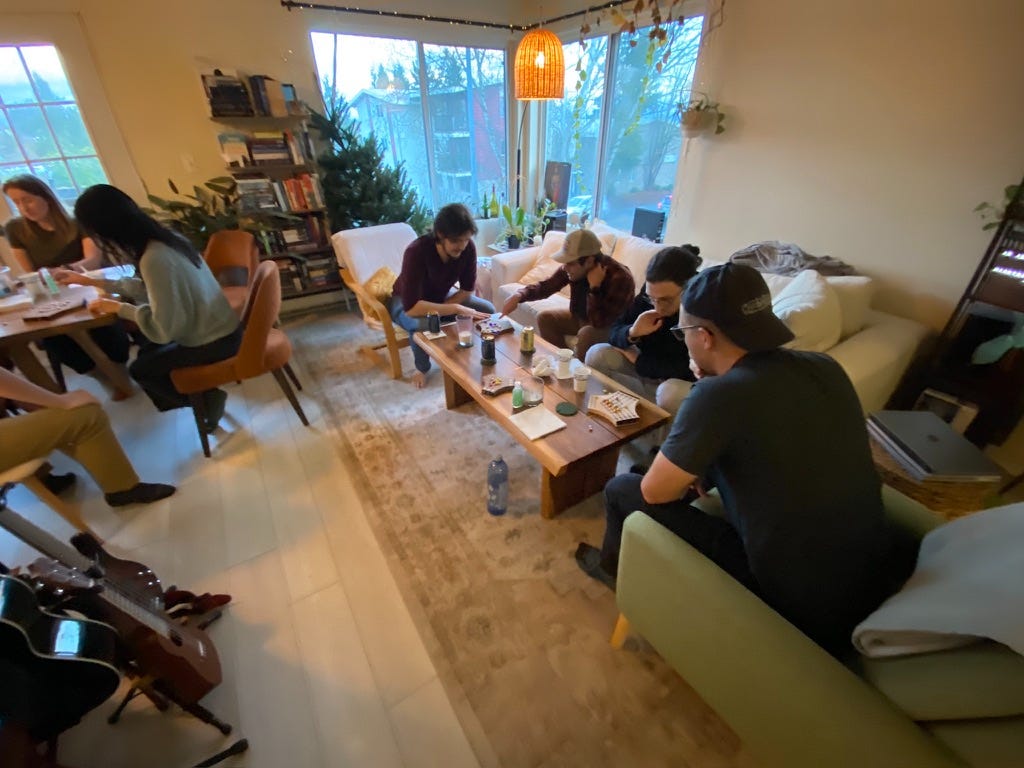
Hi readers! Changing gears from the previous long and technical post… This one’s a bit more “light” - it’s about the very first Sneaky Town tournament!
For those who don’t know, Sneaky Town is a board game I’ve been designing over the last six years. It’s a two player game in which players compete to capture points, each working with their own set of secret information. Here’s an action shot:
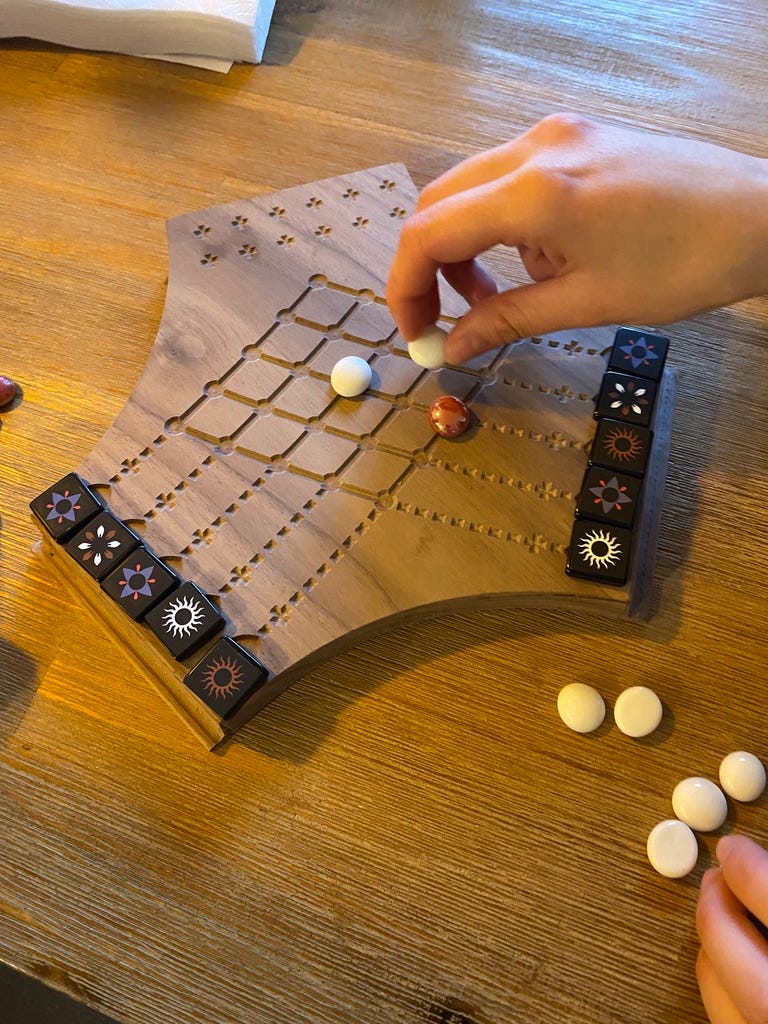
(the game also has a blog and instructions for those curious)
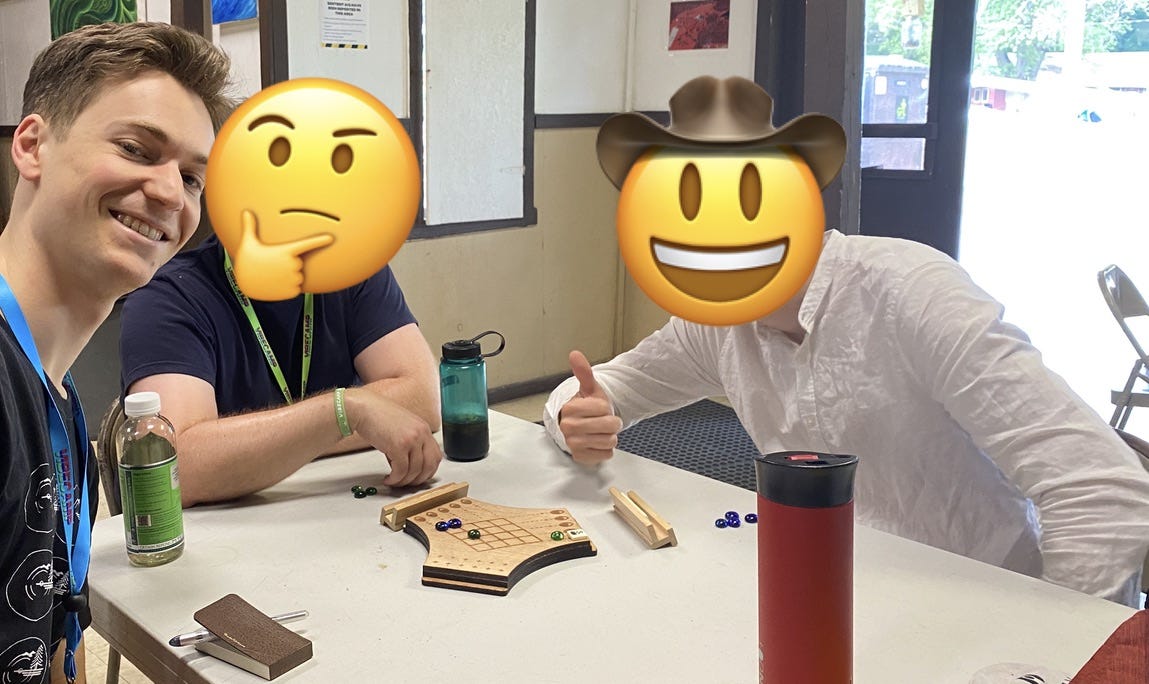
Sneaky Town has been a perpetual slow-burn side project. Over the years, many dozens of people have played, most notably a stream of competitors over a 3-day stint at Vibecamp 2:
But up until now, I’ve had just one board. Recently I made new boards, and that unlocked the ability for me to host a tournament with five (5!) concurrent games. This is the story of how that went - the lead-up, and the tournament itself, and what I learned along the way.
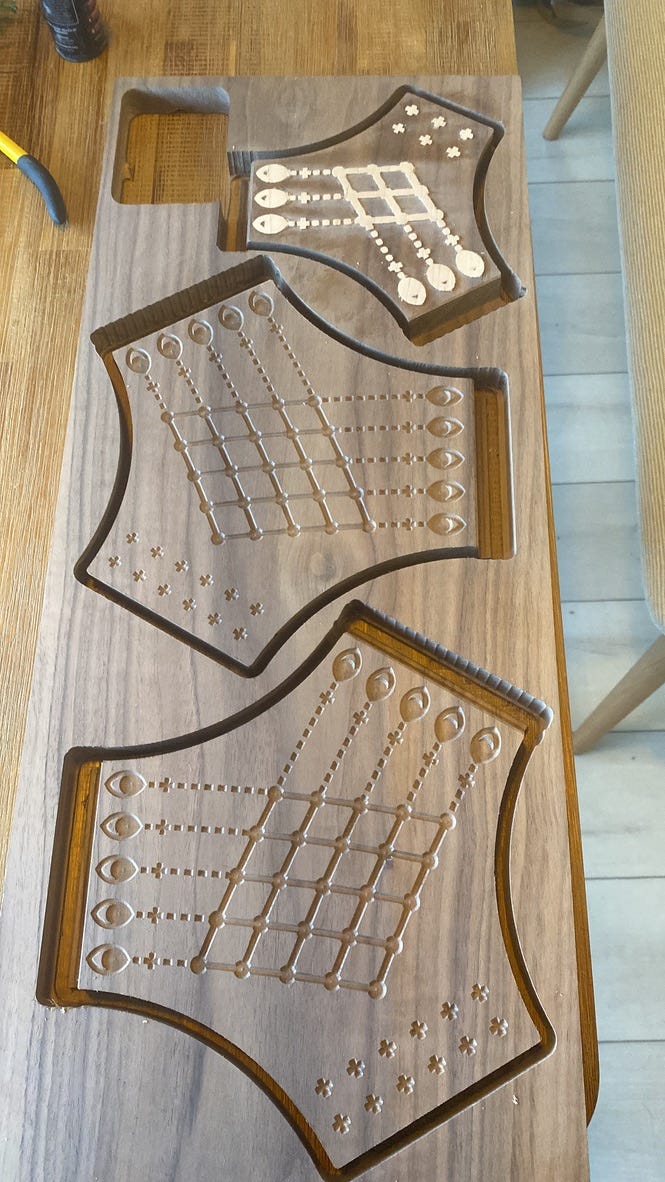
When I first came up to Seattle, I thought I was only staying a couple weeks. I had no plans other than to visit friends and take it easy. Then I found myself going to cafes and libraries and randomly started working on new tile designs and a rulebook for the game. My brother thought I might want to visit his friend “C” who works at a Seattle makerspace (Seattle Makers), in case there was any synergy with the project, so I went to check it out.
I had been to one makerspace before, Noisebridge in San Francisco, which is where I made Sneaky Town board V3. Noisebridge is an awesome place - it bills itself as “anarchistic” and it’s totally free to use. The downside of the free-ness and anarchism is that it’s disorganized and doesn’t have a lot of great machines. So, my expectations were low when I came to Seattle Makers.
I was very pleasantly surprised! They even uses a pricing system to allocate machine time... “Great market-based coordination here” I thought. C showed me around to exactly the machines that I might use to make the next set of boards - their CNC wood routers - and convinced me that it would be “easy” for me to make them there... “oh, and you need a three-part certification for the CNCs, and the next certification starts in two days, and there’s exactly one slot left.”
This felt like sufficient serendipity for me to pull the trigger and get a membership and sign up for certification. I was already considering staying in Seattle, and though I hadn’t solidified those plans, I figured I might as well make a commitment (even just to the month-and-a-half stay I was considering), as commitments are required to get anything serious done. After a couple hours I signed up, and my next stint in Seattle was secured!
After starting my new sublet and getting my CNC router certification, I began my work on the next round of boards (these would be version 4). I figured that if I was making so many boards (I planned to have four total by the end) that I might as well host a tournament, and I figured there was only one date that made sense, and that date was a week away! So I made an invite link and sent it out to my entire Seattle network.
At this point the new boards were not at all created and their designs were completely unproven... So I was simultaneously hoping I could get enough participants for the tournament while desperately trying to get the boards across the finish line. I had come to Seattle to “chill,” and here I was in an intense week-long sprint.
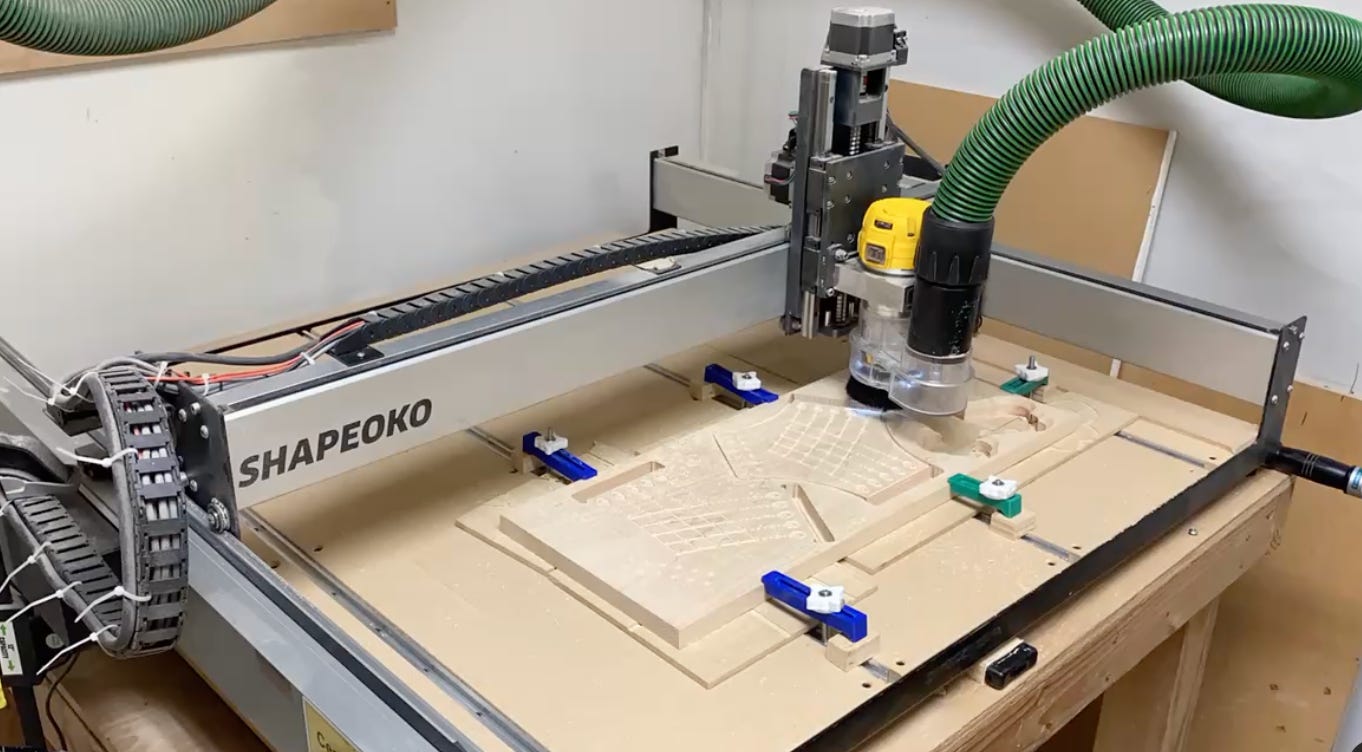
The week leading up to the tournament was fraught with logistics. Every morning I got up and spent the day before 2pm fervently tending to my flow charts and task lists. At 2pm I’d go into the makerspace and make the most of my 6-8 hours of time on their computers and machines. I had a very tight schedule assuming things did not go wrong... and many things went wrong. Including:
Software issues: VCarve, the CAM tool I was using, couldn’t import multiple 3D models - had to get clever with exporting layouts from my 3D CAD software (OnShape)
Timing issues: My CNC cut paths turned out to take way longer than I anticipated. Also, I hadn’t realized that the makerspace closed on Tuesdays.
Material issues: I learned that oil-based wood finishes were off-limits in the makerspace (as oil-soaked rags sometimes spontaneously combust), and that finishes in general take days or weeks to cure
In particular there was one evening where I was planning to run my final cuts, only to learn that I simply didn’t have time before the shop closed. I felt sick to my stomach - this was my last chance to make the boards before the tournament started. What was I going to do?
On a walk outside, my mind was racing. I decided to make the difficult decision to change my board designs and forego the wood inlay I was planning. This was devastating, as it entailed using up the last of my wood, and potentially never seeing the fully inlaid board, the pinnacle I’d been building towards for the last month.
But it was more than just a difficult decision - I still had a ton of work to do in my narrow time window. I had to quickly re-orient and frantically re-compute my cut paths to make sure my last-minute pivot wouldn’t wreck my materials. The space closed at 8pm and I took my material out of the clamps just about then.
It was a strangely crushing combination - a lot of intense work towards an outcome I was already deeply disappointed by. But when the tournament came around, everyone liked the boards. No one cared about the lofty goals to which they fell short.
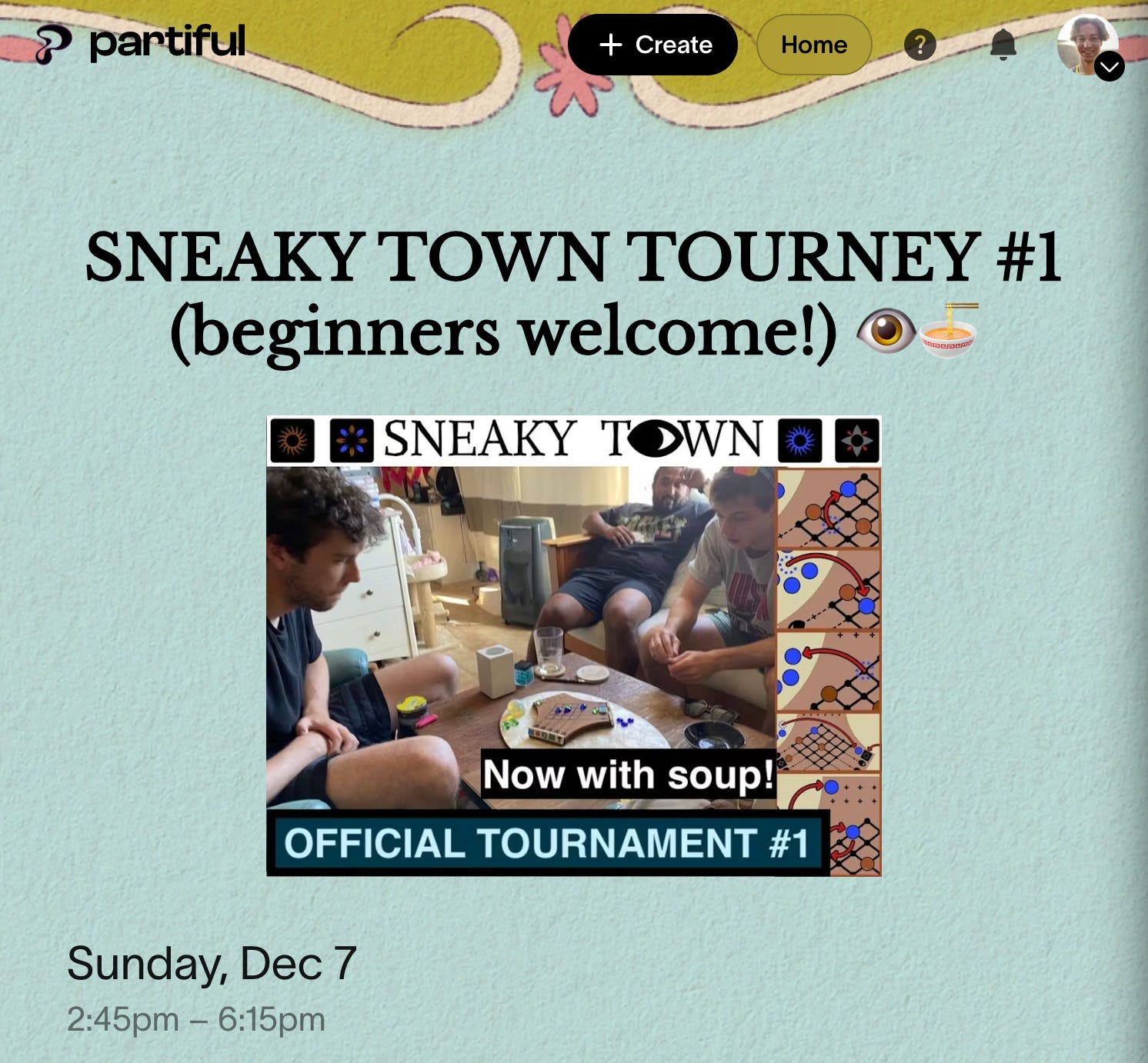
I spent a decent amount of time writing the invite. At first I was trying to make sure it was a competitive tournament, and the invite reflected that: I wanted clear RSVPs and time commitments.
But over time I realized that such strictness wasn’t really realistic, and wasn’t really the point. I changed the invite’s language to be more lax and to emphasize that it was a beginner-friendly event. I would see who showed up, and adapt the tournament to the party’s needs.
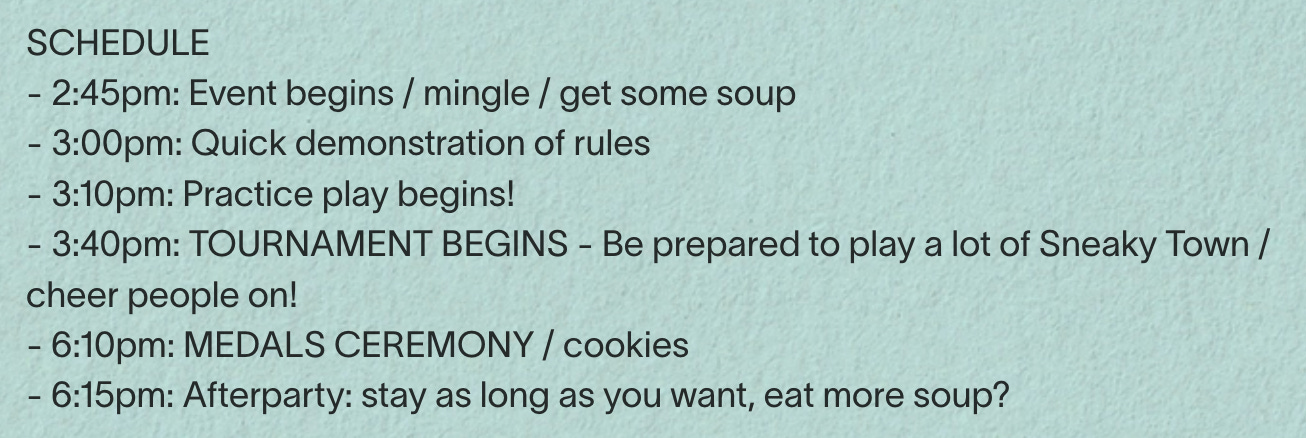
I included a specific schedule of events, to help people understand all that was planned...
And added an extensive FAQ. Altogether, I wanted the invites to get people jazzed and to leave them knowing exactly what to expect for the event.
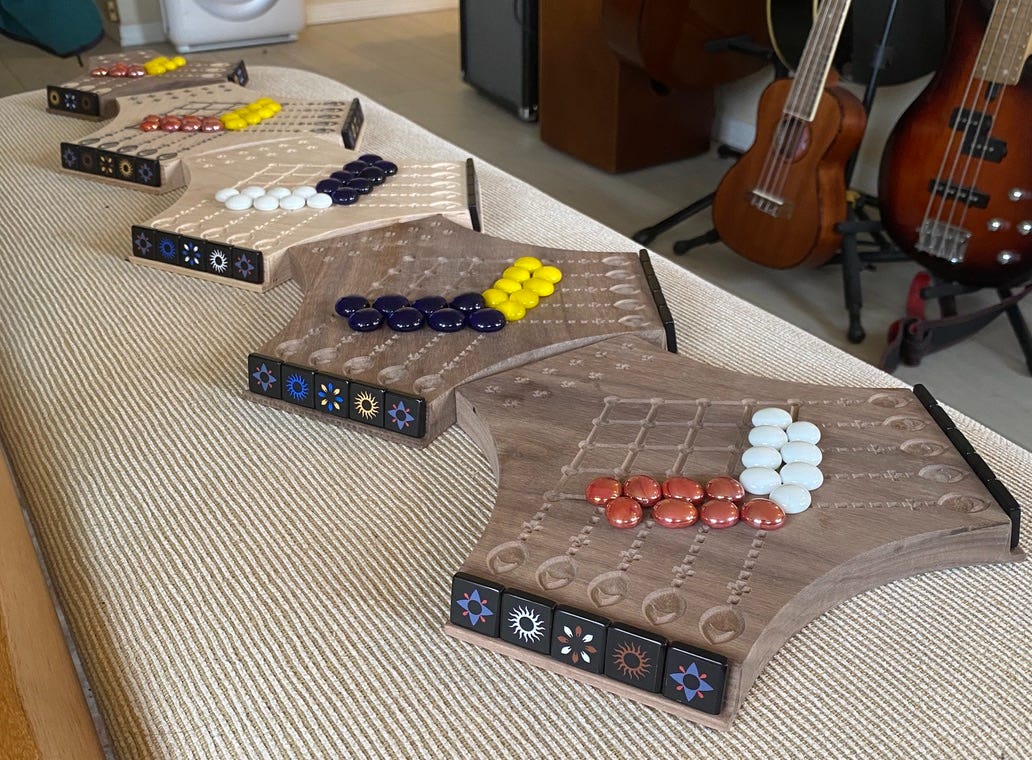
Tournament #1 was a huge success! Here’s how the new boards came out:
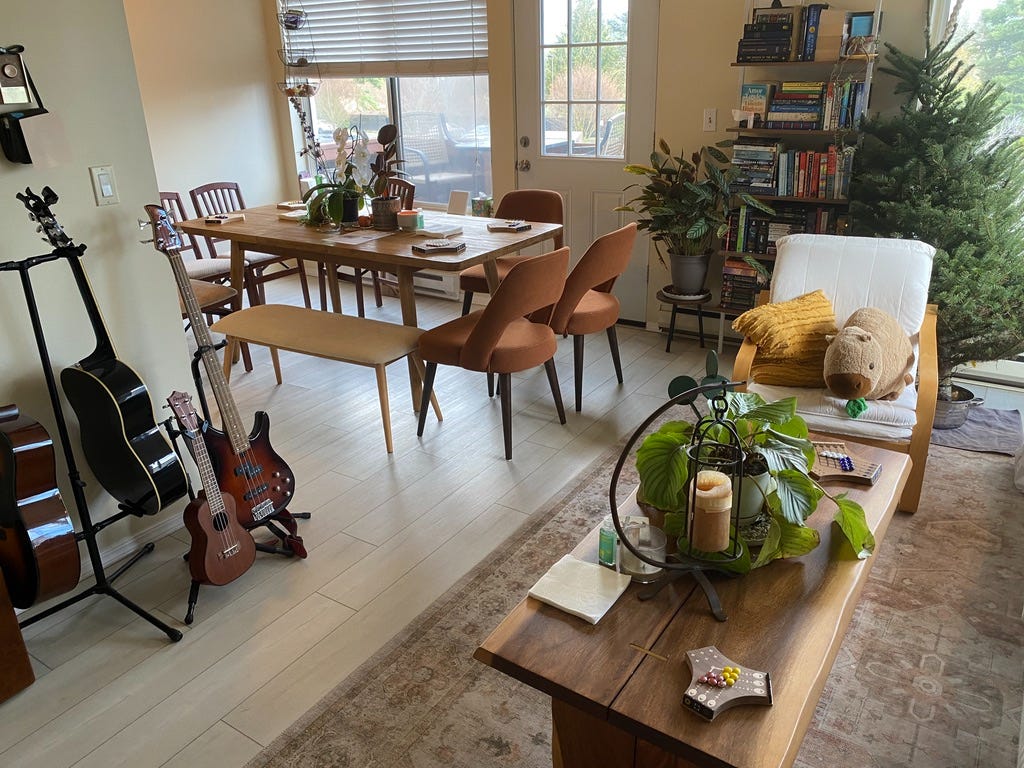
Here’s how the apartment looked before people arrived - six boards with seating around each of them:
As people filtered in I pointed them to the soup station (on the left)...
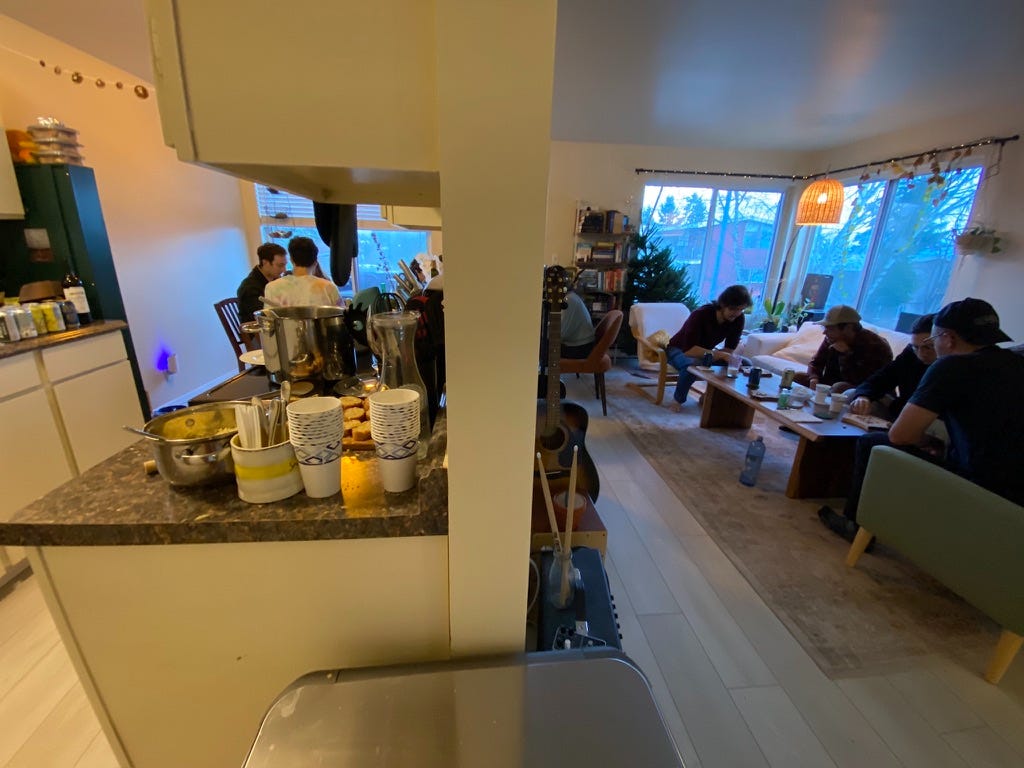
I served two homemade soups, both of which were drinkable from cups. I figured that was a nice winter food which took up little table space and kept people’s hands clean (around the precious boards).
When it came time to first corral people and explain the rules, I got to practice my public speaking skills. I was actually thinking about this quote from Kamala Harris that I found on Twitter:
When you’re standing up to speak, remember that it’s not about you...
If you’re on the Titanic, and you know the ship is about to sink, are you going to worry about how you look and how you sound? No. Cause the thing that’s most important is that everyone know’s what you know.
That was the headspace I was in - well, not that it was a Titanic-level event, but I did have a lot of teaching and instructing to do, and I sought to do so straightforwardly without worrying about my appearance.
Also, I read somewhere that it’s a host’s job to tell people exactly what to do, as people like having clear instructions. I was in that mode as well. I was happy with the event’s overall flow - people got the hang of the game, and played many rounds amongst themselves without my guidance. After I introduced the tournament section of the event and told people what to expect, I gave a “passing period” where participants chatted for 15 minutes while I set up the bracket. In all, there was a good mix of intense gameplay and laid-back socializing.
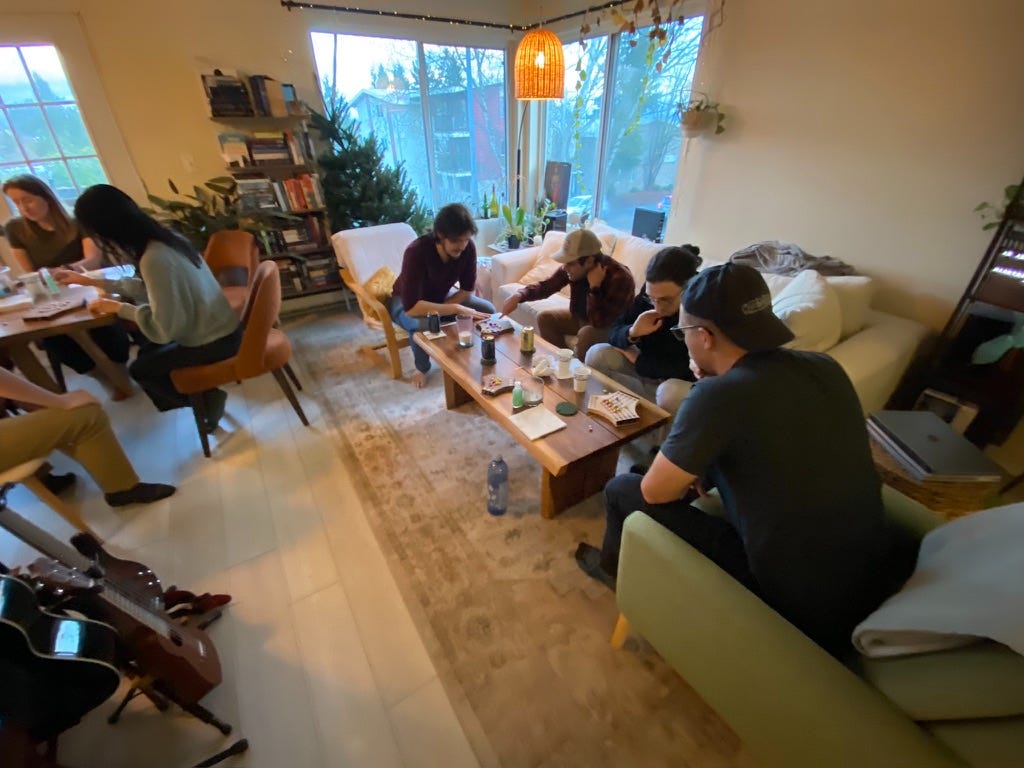
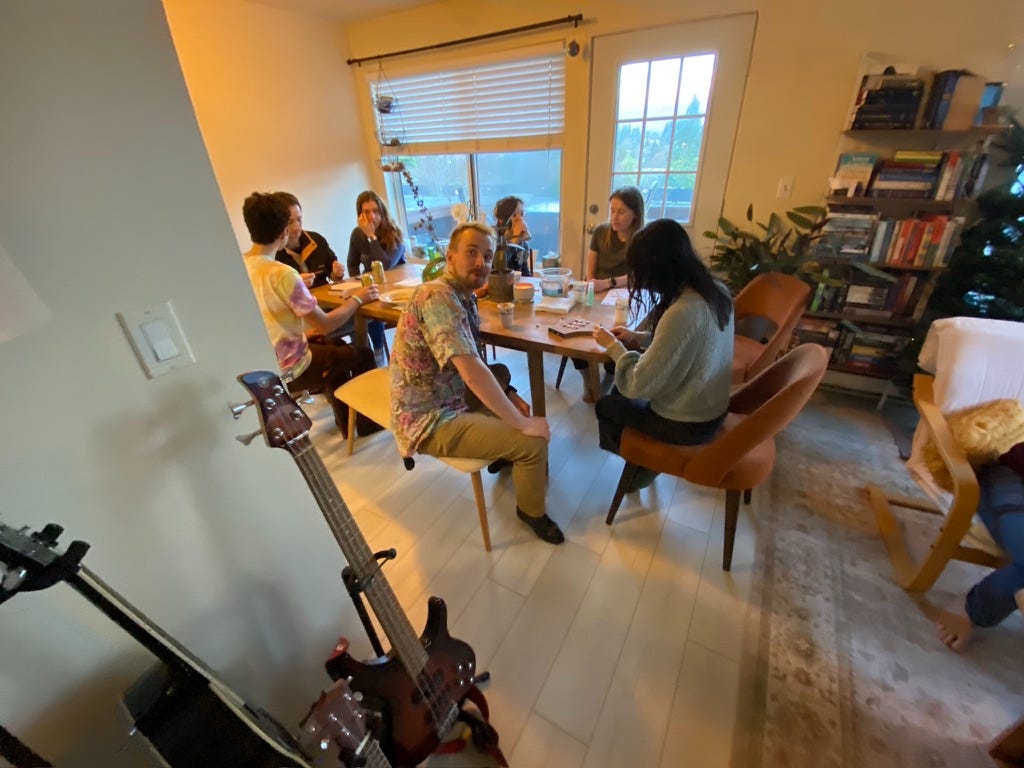
At the peak of the event there were 15 participants and five consecutive games:
I used an online bracket software (challonge) to set up a single-elimination tournament. I wanted each competition to be at least “best-of-3 wins”, because Sneaky Town is both somewhat luck-based, and a lot of strategy takes places between rounds. Ideal would have been best-of-5 or even best-of-7, but we simply did not have enough time (and I knew I was already asking a lot of people).
I also considered double-elimination or Swiss style tournament designs, but chose single elimination, again because of time constraints, and because I wanted to make sure that there was a definitive finals event that everything built up to. In the end, the tournament design was sufficient to be fun and to produce a clear winner, even if it wasn’t the most high-signal result (no offense, winners).
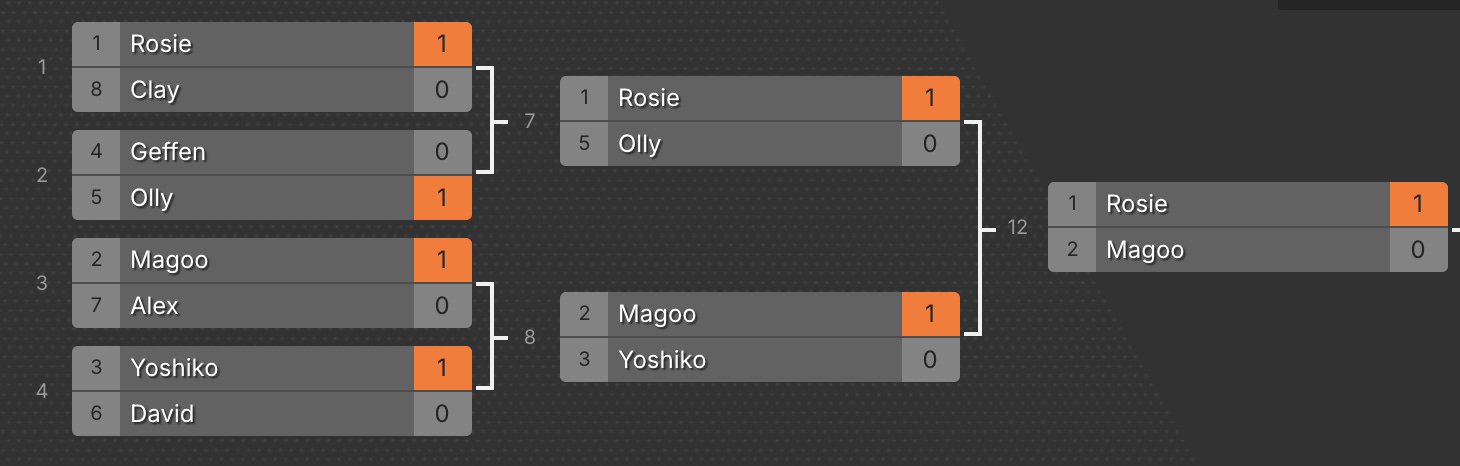
Rosie and Magoo took #1 and #2 spots respectively, and Olly and Yoshiko shared 3rd place (there was no tie-breaker for them).
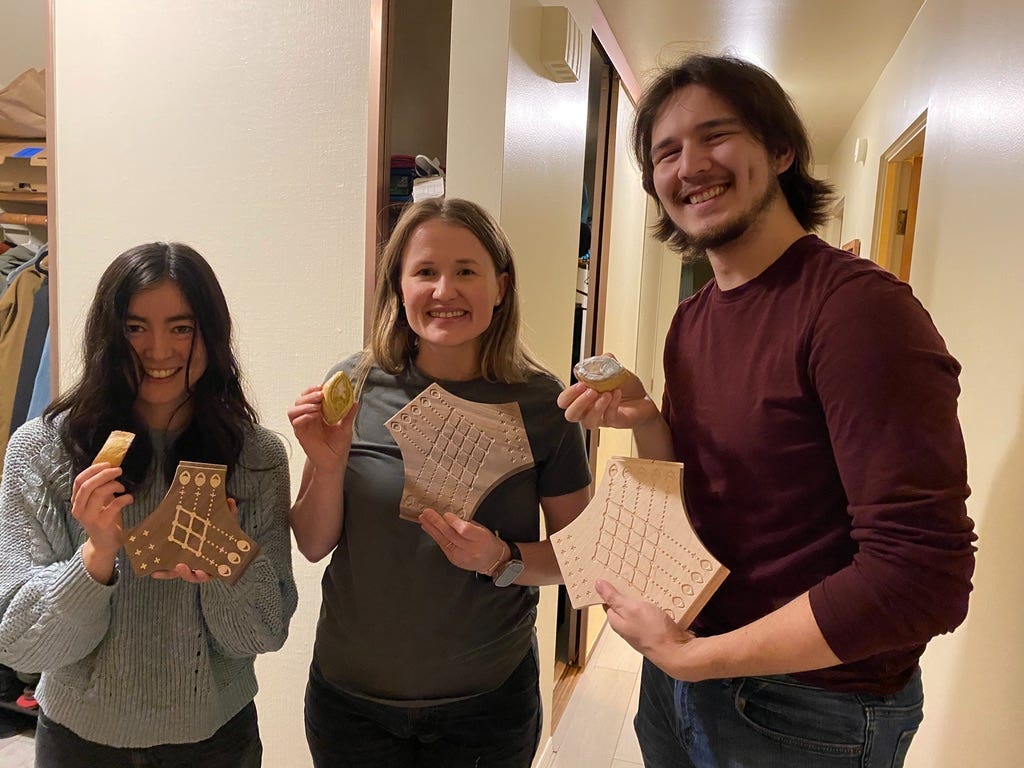
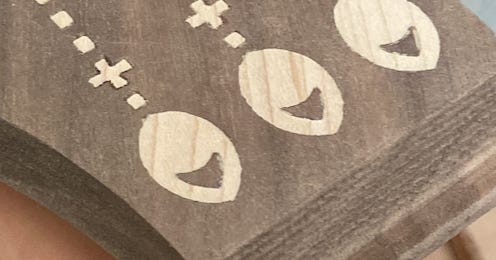
Each medal was made of lemon-cornmeal shortbread cookie with edible metallic frosting, in the style of Sneaky Town’s distinctive eye motif. The silver medal:
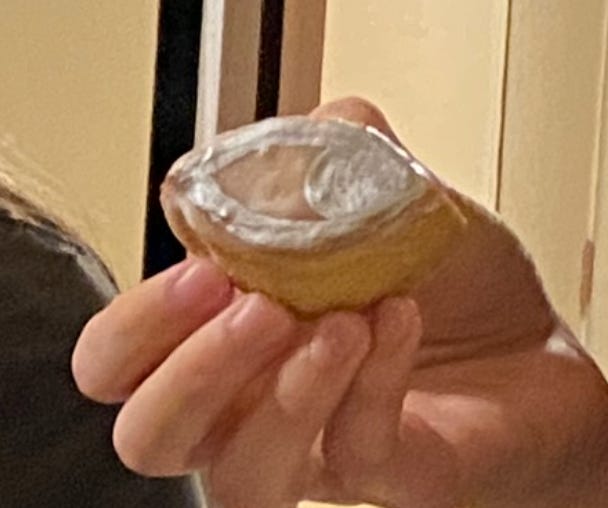
Board close-up for reference:
I think at least one medal got eaten.
... in the end, I invited everyone to stay for dinner (quiche + more soup). And the Seattle Sneaky Town community was born! This was also when I was finally convinced to stay longer in Seattle - I got such great encouragement from that group of people.
Some constructive feedback I received was that the tile racks are finicky. The obvious solution is to make them a bit deeper in future editions. Also, I noticed (and continue to notice) that players often forget certain rules (specifically, the rule that lets you move pieces around on the board). I think the solution to that problem is to improve the way I teach the game - make sure people actually go through the motion of each action themselves.
Otherwise, the feedback was super positive! This was especially rewarding coming from the players who were new to the game. I’m glad they could learn quickly and enjoy themselves, even when I had limited capacity for 1:1 teaching. But the most positive feedback I received was a request to “run it back”, which was seconded and third’ed and so-on’ed by many participants.
…So, let’s do it again! Once the boards are back in commission (they’re currently in the shop), I’ll be having another tournament. Maybe for this one I’ll also just set a date and hope that everything fills in.
I felt very rewarded, after working my tuchus off, and falling short of many of my goals, to still have made something people enjoyed.
And obviously that’s the big lesson here: “just share your projects with people before you feel they’re perfect.” It’s easy for me to get caught up in perfectionism. This tournament worked because I set a date for it and invited people and forced myself to meet the deadline. That’s what I’m doing with this blog as well: forcing myself to share my work, even when it’s not always up to my standards.
My standards are often unreasonably high and don’t necessarily map to what other people care about. I won’t know where my projects and interests fit into the world until I put them out there. This tournament was a successful example of doing so. Let’s keep sharing!