The science behind the art
The signs had to be simple and work at speed. Since 1974, France's motorway speed limit has been 130km/h (81mph), which meant drivers had only seconds to absorb what they were seeing. Each design was usually replicated on two panels, 200 to 300m apart. The first would only have the pictogram – a château, for example – to pique the driver's interest, while the second would name it, often with an arrow to direct the driver. The simple brown-and-white palette was chosen as it showed up clearly under headlights and distinguished the cultural signs from the blue-and-green signage used for motorways and major roads.

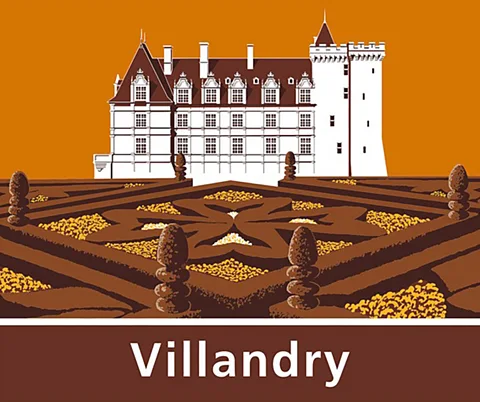 Philippe Collier
The images functioned as a universal language, able to be understood by all nationalities. When they were accompanied by text, it was almost entirely in lower case Helvetica, the typeface that Swiss typographer Adrian Frutiger had deemed the easiest to read. The French state chose each pictogram's subject, without the input of the local community. After that, it was up to Widmer and Sauvage as to how to interpret it.
"Widmer didn't patronise his viewers, he believed they were intelligent enough to understand that a fish in a dish was meant to be fish soup, for example," says Marrier, moments after I prove otherwise by incorrectly identifying a potato as a Jerusalem artichoke on one of the signs. "He deplored the road signs that came afterwards."
From minimalist symbols to illustrated scenes
In 1984, Vinci, the company that currently operates around half of France's motorways, decided the signs should become more modern and detailed. They hired Philippe Collier, a graphic designer who'd trained in fine art and spray painting, to create a new generation of panels. This time, local communities had a say in what they wanted to highlight, whether a monument, a dish, a piece of history or a regional claim to fame. For each commission, Collier travelled to the site, met with residents and built a design around what they felt defined the place. It became his life's work and he created around 950 signs over the course of his career.