The predominant narrative these days is that generative AI is going to be bad for the internet. Whether you call it Dead Internet Theory or The Slopocalypse, the idea is the same: A tidal wave of low-quality AI-generated slop will flood the internet, turning it into a lifeless shell of it’s former self.1
Maybe they’re right. I’ve certainly seen bad slop content on social media.
But I’ve also seen stuff like this:
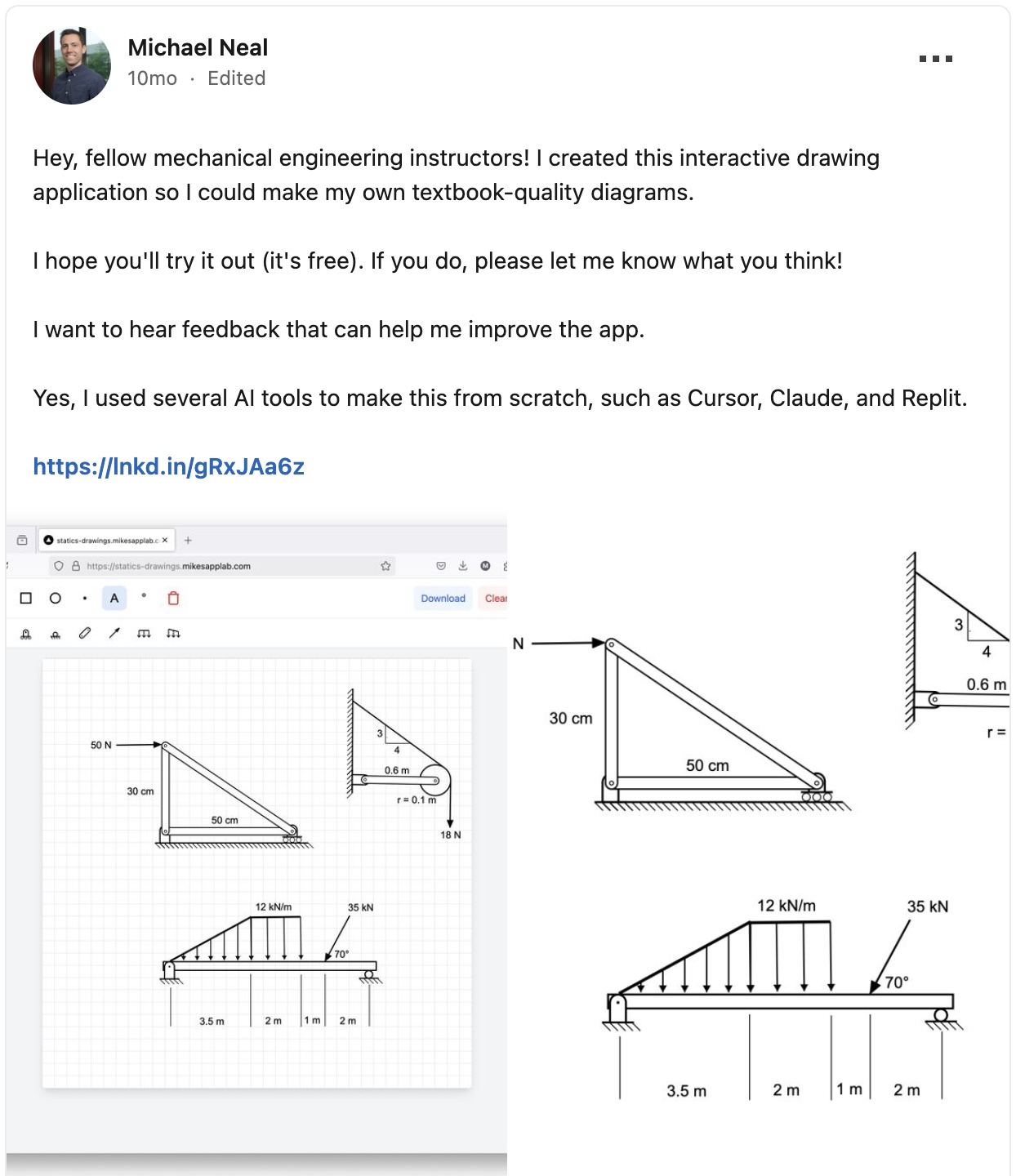
I think there’s a decent chance that we’re about to enter the golden age of the internet, and posts like the above help explain why.
A renaissance of little apps
The internet is more than just content… it’s software. It’s email clients, Pomodoro timers, drawing tools, and games. Historically, all of this software was painstakingly built by hand, which limited what we could build and publish.
But the barrier just got lower. All kinds of interesting people can build things now that couldn’t before. Artists, school teachers, sports enthusiasts, farmers, 11-year olds, scientists, storytellers, and more. Even if you’re an experienced senior engineer, AI lowers the threshold of what’s worth your time, so you can pop out goofy little toys and experiments.2 The internet is better for having all these things in it.
Apps aren’t just easier to build, though. They’re easier to maintain. I remember the frustration of pulling out my laptop on Saturday evening to work on a side project, only to spend four hours fighting to upgrade dependencies without breaking anything. That pain limited the number of active projects I could manage at once. But when an agent can upgrade all your dependencies in ten minutes, those limitations go away.
Similarly, the limitations around cross-platform development have shrunk dramatically. I’m a long-time JavaScript dev, but for the last two weeks at ClassDojo, I’ve been writing Swift, shipping features to our iOS app. This wasn’t practical until AI lowered the barrier for cross-platform work. Now, with the help of AI, a solo engineer can convert desktop apps into cross-platform apps, native apps into web-apps, or websites into progressive web apps.
To summarize, it looks to me like we have all the ingredients for a renaissance of little apps:
- More apps are born as the threshold for building goes down.
- Apps live longer as the threshold for maintenance goes down.
- Reach becomes wider as the threshold for cross-platform development goes down.
The arguments against
Even if there’s a proliferation of new, interesting, web software, there are several arguments for why it will fail to improve the internet we have today. Let’s look at a few of them:
Argument 1: AI-generated software is unoriginal/low-quality/slop
AI generated content is kindof a bummer, but AI generated apps don’t have to be. A software tool has the same utility to the end-user whether the code was written by an AI or by hand. The end-users of software don’t read the code and don’t care about the code. They care whether it solves their problem.
Now maybe you think that AI-generated software is inherently buggy. Software has always been buggy, but to the degree that you feel AI-generated software is worse, consider the forces at play. Users hate buggy software, and in a world with lots of options, fast and stable software will attract the most users. We’re all still learning how AI will contribute to that outcome, but the point is that Slop is Not Necessarily the Future.
Maybe you think that AI-generated software is inherently tacky because it all looks the same. Us web-devs can be discerning about that kind of thing, but normies don’t care. All of these UIs look better than what the median software UI looked like 10 years ago.
And for the creators that do care, AI lets them put their time where it matters. Three years ago it might have taken you twenty hours to build a portfolio site. Today, you can have AI build out the plumbing in less than an hour, and spend the other nineteen hours iterating on the aesthetic. An internet where more people are doing that feels to me like an objectively better place!
Argument 2: Search is broken
I believe that the quantity of good stuff on the internet will continue to increase, but does that even matter if we can’t find it, amidst all the incoming garbage?
Of course, the vast majority of the internet has always been garbage, but It never really mattered, because of Search.
Now maybe you don’t trust Search to save us anymore. It’s common these days to see articles about how Search is broken, search result quality is declining, and so on.
But Search is rapidly changing, right now, for the first time in a long time. AI gives competitors an actual shot at disrupting Google, who no longer has the luxury of trading user experience for higher profits from their monopoly position. Now, I don’t know how this is all going to shake out, but if anyone can consistently surface the best resources the internet has to offer, I expect they will be rewarded. The incentives are there.
Argument 3: Social media is pervasive and toxic
How can the future internet be good, when it feels like social media has taken over, polarized everything, poisoned the public discourse, and given the rising generation a mental health crisis?
It’s a fair question. I currently feel like social media is net negative to society. Not much to sugar-coat there.
It may be helpful to think of social media like a virus. It’s caught our culture off-guard and it’s making us sick. But the body won’t tolerate sickness forever, and our cultural immune system is working on anti-bodies that will get us to a better place. Last year, my daughter’s high-school implemented a school-wide ban on phones during the school day. The EU is experimenting with increasingly strict social media legislation. And individuals (including me, and many in Gen-Z) are finding their own ways to opt-out of the nonsense.
Hopefully this trend continues and leads to better times ahead. The worst may already be behind us.
Argument 4: Software is dead
Some AI boosters think that all websites, apps, and software will soon become extinct… replaced by powerful AI interfaces that can generate whatever you want (apps, resources, entertainment), on-the-fly. I don’t buy it (and I’m not alone).
Anyone who has used a chat or voice-based AI for a non-trivial amount of time knows how exhausting it can be to get the specific thing you want. The user has to initiate a request, accurately understand their own needs, and then accurately communicate them. All of that is cognitive load.
In contrary, a well-designed piece of software serves as a domain-expert for a need, anticipating the user’s sticking points, and visually helping overcome them. The result is cognitive relief.
We could say more about this, but if you’ve ever felt AI fatigue, you already know. We’ll still need plenty of web software in the future.
The “Golden Age”
Ask ten people when the “Golden Age” of the internet was and they’ll give you ten answers. It has more to do with how old you were when you went online for the first time than any objective criteria (it’s similar to people’s taste in music, in that way).3 So I understand that predicting an upcoming “Golden Age” of the internet is a fraught position to take. Nostalgia is powerful and the old internet is never coming back.
But change is not always bad. It’s the wellspring of energy, enthusiasm, and curiosity. There are a lot of excited people out there right now. It won’t always be like this.
If we want to see the good kind of change, then we have to build it. We can use AI to flood the internet with interesting little toys and apps. We can use our time savings to experiment and build things from scratch that AI can’t imagine. And we can continue to connect and share in healthy and positive ways—it’s never been easier to spin up a blog and share what you’re working on.
With a bit of luck, we’ll look back on today as a uniquely special time. Why not?