Earlier this month, I read a more equivocal take about the golden age of a different medium entirely. The ensuing discussion helped crystallize an inkling I’ve been accumulating over the past few years: This is the golden age of video games.
What exactly do I mean by golden age? Let’s see what people mean when they talk about golden ages in other media. I probably mean something like that.
- The golden age of film is the 1930s.
- The golden age of television, then called Peak TV, is the late 2000s and 2010s.
- The golden age of rock is the late 1960s and 1970s.
- The golden age of arcades is the 1980s.
- The Golden Age of comic books is the 1940s and early 1950s. It’s the only one of these people typically capitalize.
One thing common to all of these eras is that we judge them on their works. We don’t consider how exploitative or soul-crushingly grinding it might have been to work in those mediums at that time. While the AAA game industry may be a hellscape of crunch and layoffs, and the indie gaming environment may be a rigged idealists’ lottery, that isn’t evident in the results.
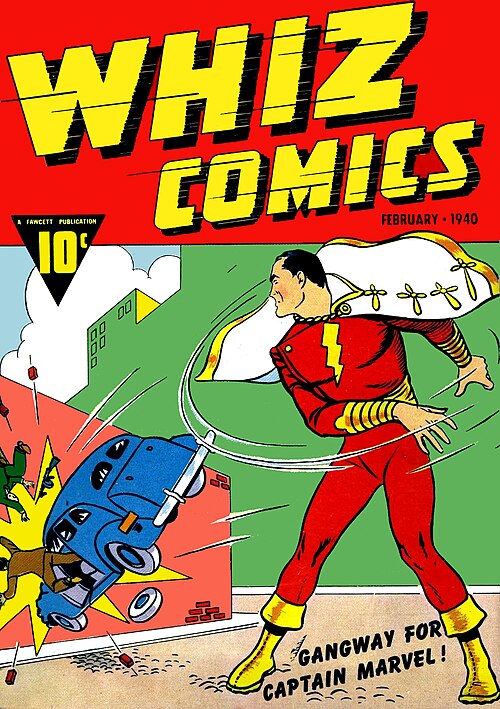 1940 cover of issue 2 of comic book Whiz Comics. Captain Marvel, a superhero with a red costume featuring a yellow lightning bolt emblem on his chest, throws a car into a wall. The label “Gangway for Captain Marvel!” appears in the lower-right.
Living through a golden age doesn’t feel like anything in particular. In the 2010s we talked enthusiastically about how good specific TV shows were, but rarely about the overall environment. It’s not apparent when you’re in the middle of something special until you look at it in retrospect.
If you compare an original PlayStation game to a PS2 game, it’s immediately obvious which is which. This is much less true when you look at a PS4 game and a PS5 game. You could put any obscure game from the last ten years in front of me and claim that it came out yesterday, and I’d be hard-pressed to disagree.
This recent technological plateau coincides with the maturation of game design as a field. Many early games include lots of jank and mechanics that worked by chance, not design. Copying known good mechanics worked well for decades, but struggled to generalize. Instead, games from the past ten years are typically designed from the ground up through prototyping and iteration. They tend to play noticeably differently and feel more natural as a result.
A third background thread is video games shedding their perpetual hangup around being taken seriously as a medium. The scent of desperation is gone. One sign of this is the rise of prestige video game adaptations like Arcane, Fallout, and The Last of Us. Another factor was the 2020 pandemic and its enforced isolation leading a wider selection of people to look into video games. It’s finally unremarkable when sitting US senators play video games; it’s just another hobby like golfing or going to the movies.
You might object the 1980s and early 1990s should be the golden age of video games, aligning it with arcade games, and we should call this decade a silver age or a renaissance. It’s a solid argument. I’d claim that comparing Super Mario Bros. or The Legend of Zelda to Super Mario Odyssey or Tears of the Kingdom is like comparing apples and oranges. They’re different kinds of things, in the same way that 10-minute silent films are different from 90-minute talkies. You can, and people do, still make and appreciate 10-minute silent films. But they’re fundamentally different things.
I actually see a lot of parallels between the early history of film and the early history of video games. The 1900s and 1910s saw many pioneers create art worth appreciating and remembering despite straining against technical constraints. I feel a sense of awe and wonder when I think of people exploring a protean medium, rife with possibility, communally discovering its unique strengths. I feel the same way about the 1980s and 1990s in video games.
When I think about the maturation of film as a medium, it seems to have required sound, but not color. Video games will likely see innovations on the scale of color film in the future, but that doesn’t preclude game design from being the factor that pushed them over the threshold into maturity.
As a first approximation, let’s bound this era as the late 2010s and 2020s. It aligns with the 10-15 years we see in other media. That’s my case future hobbyists will describe it as the golden age of video games.
For concrete examples of golden age works, let’s look at influential video games. Here’s four contemporary games that struck on something so resonant they inspired entire genres:
- PlayerUnknown’s Battlegrounds (2017)
- Slay the Spire (2019)
- Vampire Survivors (2021)
- Balatro (2024)
The other side of influence is uniqueness. Painfully novel games that shouldn’t exist, created through an unreasonable amount of effort, now regarded as unrepeatable masterpieces. Here’s eight contemporary singular video games:
- Outer Wilds (2019)
- Baba is You (2019)
- Disco Elysium (2019)
- Inscryption (2021)
- Tunic (2022)
- UFO 50 (2024)
- Caves of Qud (2024)
- Blue Prince (2025)
Neither of those lists is even the list of the best games! These are just lists of games that were often copied, and games that were uncopyable. I leave the list of the best games of the last ten years as an exercise for the reader.