Pascal compilers for the MSX
 The Pascal language was named after Blaise Pascal (see picture), a French mathematician who was a pioneer in computer development history. In 1641, at the age of eighteen, Pascal constructed the first arithmetical machine, arguably the first computer. He would improve upon the instrument eight years later. In 1650, Pascal left the world of geometry and physics, and shifted his focus towards religious studies, or, as Pascal wrote, to “contemplate the greatness and the misery of man.” Pascal died in Paris on August 19, 1662.
Niklaus Wirth completed development of the original Pascal programming language in 1970. He based it upon the block structured style of the Algol programming language. There were two original goals for Pascal. According to the Pascal Standard (ISO 7185), these goals were to a) make available a language suitable for teaching programming as a systematic discipline based on fundamental concepts clearly and naturally reflected by the language, and b) to define a language whose implementations could be both reliable and efficient on then-available computers.
Pascal was used in the seventies and eighties as the computer language in programming education. It served as the main programming language to teach structured programming.Many compilers were available for all current platforms these days. The language itself is a standard now (ANSI) but also served as model used by Wirth for more advanced (modular) languages such as Modula and Oberon.
Borland produced Turbo Pascal both for CP/M and MS-DOS, version 3 was a huge success and much of the software in the eighties on small computers is written with Turbo Pascal. Alas it was not standard Pascal, instead very practical adapted to the CP/M and MS-DOS environment.
Read this great introduction how to write GOOD programs!
Turbo Pascal may not be the only Pascal compiler running on MSX, it is the best supported one.
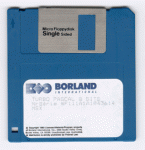
The untouched and not installed version(see the Pascal course in MCCM part 1!):
A version of Turbo Pascal was distributed by Philips. In the package you find:
- Turbo Pascal 8 bits MSX This version was a real Borland product, as you can see on the floppy label.
- A book by Jeff Dunteman with demo disk “Turbo Pascal Compleet”,
 Manual, Front and Back CoverBelow are scanned images of the front and back covers of the Turbo Pascal 3 manual. Back in those days the manual was the product. The floppy disk placed inside the manual cover along with the license agreement, invitation to join on CompuServe forums and other paper marketing pieces. Click on each image to display a larger version of each cover.
A patched and installed version
Turbo Pascal DataBASE Toolkit 1.2 , official add-on by BorlandFor MS-DOS with debugger (handy crosscompiling!)
- Graphpak, Uwe Schroder’s Pascal Bios include files
- The Beunsoft Pascal Bios include files Turbo-Lib V3.0 (courtesy Jacoon Bastiaansen)
- MDL-LIB 2.2 Pascal Bios include files
- The large collection of Kari Lammassaari Pascal MSX support files
- For programming RS232C devices such as the Sunrise and Philips modems etc Erik Maas made a Turbo Pascal interface to his fossil driver
Martijn Dekker, the author of the Turbo Pascal package MDL-LIB has given permission to publish the latest and greatest version 2.2 and declared it public domain.
Slotman has made an IDE for Turbo Pascal 3.3 running on the PC (Windows). You can find it here in the utils section.
INL Pascal library
Hans Otten Pascal programs
When i wrote them it was the dark age of MS-DOS, so I used Turbo Pascal and as graphical file format PCX. It still works, even under Windows 95/98.
CNVS version 2.3 : MS-DOS program to convert MSX screen 0-8 to PCX and back including sources
This 2.3 version is a recent update (june 1999), is now in English and with a cleaner syntax.
CNVS version 2.1 : old MS-DOS program to convert MSX screen 0-8 to PCX and back in dutch only.
MSX12CNV: MS-DOS program to show or convert MSX screen 12 (in full color)
MSXCNV12: MS-DOS program to show or convert PCX on the PC to MSX screen 12 (in full color)
Quickbasic program to convert RAW file (create with Paintshop PRO) to screen 12 full color by Hans Schoormans
On request: a Windows 95/98 program to convert MSX screens to and from PCX
PCX format description the official guide how PCX is done
INDEX MSX and MS-DOS programs to build a database of files on your floppies with Pascal sources
My MSX pascal include libraries
- Cmdline pascal source added, its a good example how to use the commandline and read/modify sectors on a disk using standard CP/M (and so MSX-DOS) calls.
- Three programs to help write inline code for Turbo Pascal:
- INLINE program by J.A.C.G. van der Valk to translate REL files to inline made with the M80 macro assembler: Pascal source and program
- INLASS, a Z80 macro-assembler that generates inline code (also 8080, 8086 and 6502 cpu supported): Pascal source and program , documentation
- PMLINE: Adaptation and enhancement of a MC program called PMLine, article by Werner Cirsovius and the program
- A Turbo Pascal program with source to show inverse characters on screen 0 and 1
- A Turbo Pascal program with source to split a text file or Wordstar file in two columns per page
- Directory in Pascal with BDOS calls
- Sources of SDOS by Juan Salas: a file manager with windows
- Pascal source of a program to digitize on the MSX video computers by Juan Salas Pascal sources and other files belonging to the Pascal magazine articles.
- CUC journaal mei 1988
- CUC journaal juli 1990
- CUC Journaal Vraag directory op in Pascal met BDOS calls
- MCCM 61 Pascal uitgediept: instellen en gebruik JANSI
- MCCM 63 Pascal uitgediept: muis in Pascal
- MCCM 65 Pascal uitgediept: Pascal sneller
- MCCM 66 Pascal uitgediept: gebruik variabelen
- MCCM 67 Pascal uitgediept: gebruik geheugen
- MCCM 68 Pascal uitgediept: data
- MCCM 69
- MCCM 70 Pascal uitgediept; vulpatronen
- MCCM 71 Pascal Uitgediept directives
- MCCM 72 Pascal Uitgediept: recursie
- MCCM 75 Pascal uitgediept scherm 0
- MCCM 90 Finse libraries Manuel Bilderbeek licht de Pascal libraries van Kari Lamassaari toe
- Software , behorend bij MCM artikelen
- MCM 37 Bespreking Graphpak environment en patch voor Pascal (BREAK!)
- MCM 40 Bios bereiken vanuit Pascal
- MCM 45 MDLLIB pascal library bespreking
- MCM 51 GIOS grafische I/O Ssyteem voor Pascal
- Software , behorend bij MSX CLub Magazine artikelen
- MSX Club Magazine
