The business magnate tycoon is first seen in 1857 as a transliteration of the Japanese honorific 大君 (taikun). It was a term of respect for the shogun of Japan, indicating that while he was neither the emperor, nor of imperial lineage, he was nonetheless the head of state. In 1861, US Cabinet members started jokingly referring to President Lincoln as the Tycoon. Tycoon’s meaning generalized to any important person in business during the late 1800s.
大君 has an exceptionally long history. It was the Japanese shogun’s diplomatic title for over 250 years, until the shogunate’s dissolution in 1868. Tokugawa Hidetada, the shogun from 1605-1623, first chose the title as a rebuke to Chinese imperialism. For over a thousand years, East Asian rulers had deferred to China under the custom of 外王内帝, “Emperor at home, king abroad”. Under this system, domestically rulers could style themselves 帝 (dì), meaning “emperor”, but internationally they had to be called 王 (wáng), meaning “king”, in deference to the Emperor of China (皇帝) ruling above them all. Tokugawa chose to be called “not emperor” to thumb his nose at the practice, while not actually asking to be crushed by the Ming military.
Japanese Empress Kogyoku (ruling 642-661) was the first recorded monarch to use the title 大君 over the customary 天皇 (tennō), signifying that she was not a direct descendant of the legendary emperors. This echoes the title’s c. 800 BCE usage in the 易經 (I Ching; Yijing in modern transliteration), also denoting a ruler without any imperial lineage.
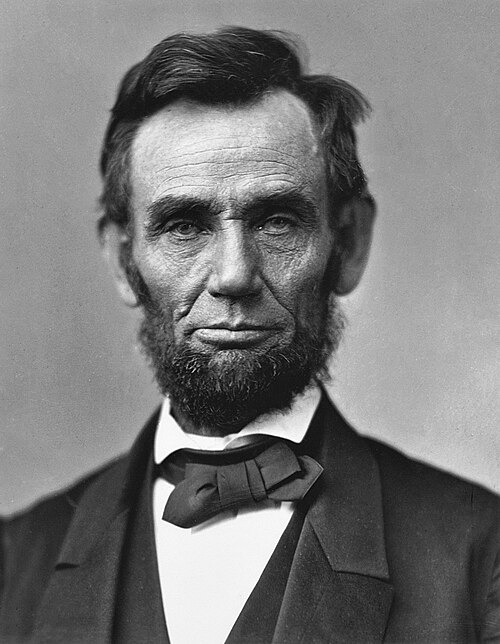 1863 photo of Abraham Lincoln. The iconic black-and-white photograph features Lincoln staring directly at the camera. The texture of his skin looks strangely overemphasized, typical of many photos from the 1860s.
The names describing Gilded Age robber barons like Morgan, Carnegie, Rockefeller, and Charles Schwab[1] have a pleasing diversity of origin. Tycoon is from Japanese. Magnate is from Latin magnātēs, meaning “great man”. Baron is from Norman French barun, meaning “baron”. Mogul is from Iranian Persian مغول (moġul), meaning “Mongol”. That is, people from Mongolia, specifically the rulers of the Mughal Empire, people rich and powerful enough to construct the Taj Mahal.
The video game genre tycoon games where you manage a business are named after Railroad Tycoon (1990). The genre actually predates video games, with notable early examples The Sumerian Game (1964) and M.U.L.E. (1983), but didn’t get its current name until the 1990s. The most notable tycoon game series with tycoon in its name is RollerCoaster Tycoon (1999).
There’s also an unrelated card game called “Tycoon”, although I learned it as the drinking game “Asshole” in the 1990s. Some other English variants include “President”, “Tichu”, and “The Great Dalmuti”. They seem to all be ultimately based on a card game invented in Shanghai in the 1950s called 争上游 (Zhēng Shàngyóu), meaning “Struggling Upstream”. A more recent popularity bump can be attributed to Japanese variant 大富豪 (Daifugō), meaning “Grand Millionaire”, appearing in the 2004 translation of the manga フルーツバスケット (Fruits Basket).
[1] Apparently the most effective way to obliterate a famous billionaire from history is the emergence of an unrelated famous billionaire who happens to have the same name.