The level of competitiveness varsity was first applied to sports in 1891. Varsity is a clipping of univarsity, a regional pronunciation of university found in slang since the 1700s. The institution for higher education university was borrowed into English from Norman French université around 1300. Université is a direct descendant of Classical Latin ūniversitās, through Old French universitei and Medieval Latin universitas. Its Latin roots are ūni, meaning “one”; versus, meaning “turned” (later borrowed into English meaning “facing”, then “against”); and tās, a noun-forming suffix akin to the “ity” in “ability”. A thing turned into one. Classical Latin ūniversitās means “the whole” or “the entirety of”, as in the later borrowing universe.
How did a word that originally meant “the entirety of” come to mean a specific kind of institution for higher learning? The answer lies in the institution’s medieval European origins. Centers of higher learning have flourished since the Iron Age. The words we use to describe them today include the generic term school,
Madrasa (مدرسة) is the generic word for “school” in Arabic, derived from the root for learning D-R-S. Vihara (विहार) roughly means “monastery” in Sanskrit, though its original meaning was “inn” or “recreational center” 2300 years ago. Xué (學) is the generic word for “study” or “school” in Chinese, derived from a root meaning “awaken” or “gain awareness”. Academy (Ἀκαδημία) was the name of the person who owned the grounds the first academy was built on. Lyceum (Λύκειον) was an epithet of Apollo from a root meaning “light”, which came to represent a particular statue of Apollo, then the building where the statue stood. The Museum (Μουσεῖον) was a specific shrine dedicated to the muses.
In this context, it’s easier to place the university as the Christian equivalent of a madrasa or vihara. The first universities were cathedral schools or monastic schools before they became something different. The 1088 University of Bologna, 1096 University of Oxford, and 1150 University of Paris were officially certified as something different after a 1231 papal bull that established the university as distinct from the church. Its students nevertheless enjoyed clerical immunity to prosecution under civil law.
The oldest universities were not called that until the 1200s, as a short form of the phrase universitas magistrorum or universitas scholarium, meaning “encompassing all teachers” or “encompassing all schools”.
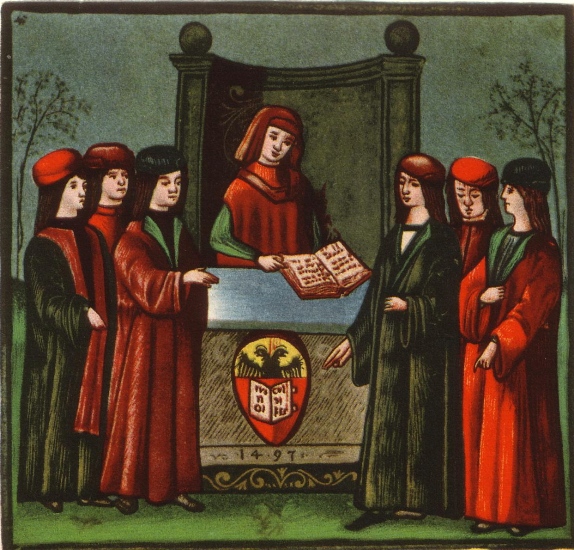 1497 illuminated illustration of students enrolling in the University of Bologna. Six long-haired students in green and red caps and robes stand outside, surrounding a desk and throne bearing the university seal. A robed person sitting in the throne writes in an open book.
500 years later, when English scholars sought to bring these traditions to North America, they felt their initial efforts were too feeble to warrant the term “university”. They used the word for a single department instead, college. The nine colleges established within the Thirteen Colonies were Harvard College in 1636, the College of William & Mary in 1693, the Collegiate School (now Yale) in 1701, the College of New Jersey (now Princeton) in 1746, King’s College (now Columbia) in 1754, the College of Philadelphia (now Penn) in 1740, the College of Rhode Island (now Brown) in 1764, Queen’s College (now Rutgers) in 1766, and Dartmouth College in 1769. Huh, why aren’t William & Mary and Rutgers grouped with the other seven today?
College became the English word for a single university department around 1400, through another borrowing from French. French college is directly descended from Classical Latin collēgium. Its Latin roots are con, meaning “with”; lēgō, meaning “appointed”; and ium, a noun-forming suffix. People appointed together. That makes sense; it’s the same root as colleague. So a college was a society of colleagues working toward the same goal. Or perhaps fellows.
In any case, in US English college stuck as the generic term for tertiary education, even as university accreditations became common in the late 1800s. So varsity sports became the term for intercollegiate competition. Junior varsity enters usage in 1902.