EXTRA, extra! Today I’m launching Future Stories, my own podcast about technology, science and the way we live.
The first guest is Vint Cerf. He co-designed TCP/IP with Bob Kahn in the 1970s, the rules that let the world’s networks talk to each other. Interviewing him was on my bucket list for years. When I was at Cloudflare I thought about asking him many times, but I was a bit shy. He’s Vint Cerf, after all. This year I finally asked, and he said yes.
We talked over Zoom (not using Zoom again) on October 14. He’s 83, he left Google this year after more than twenty years, and he’s helping start a company, Tolero, that is building software for an Internet between planets. His words: “the speed of light is too slow.”
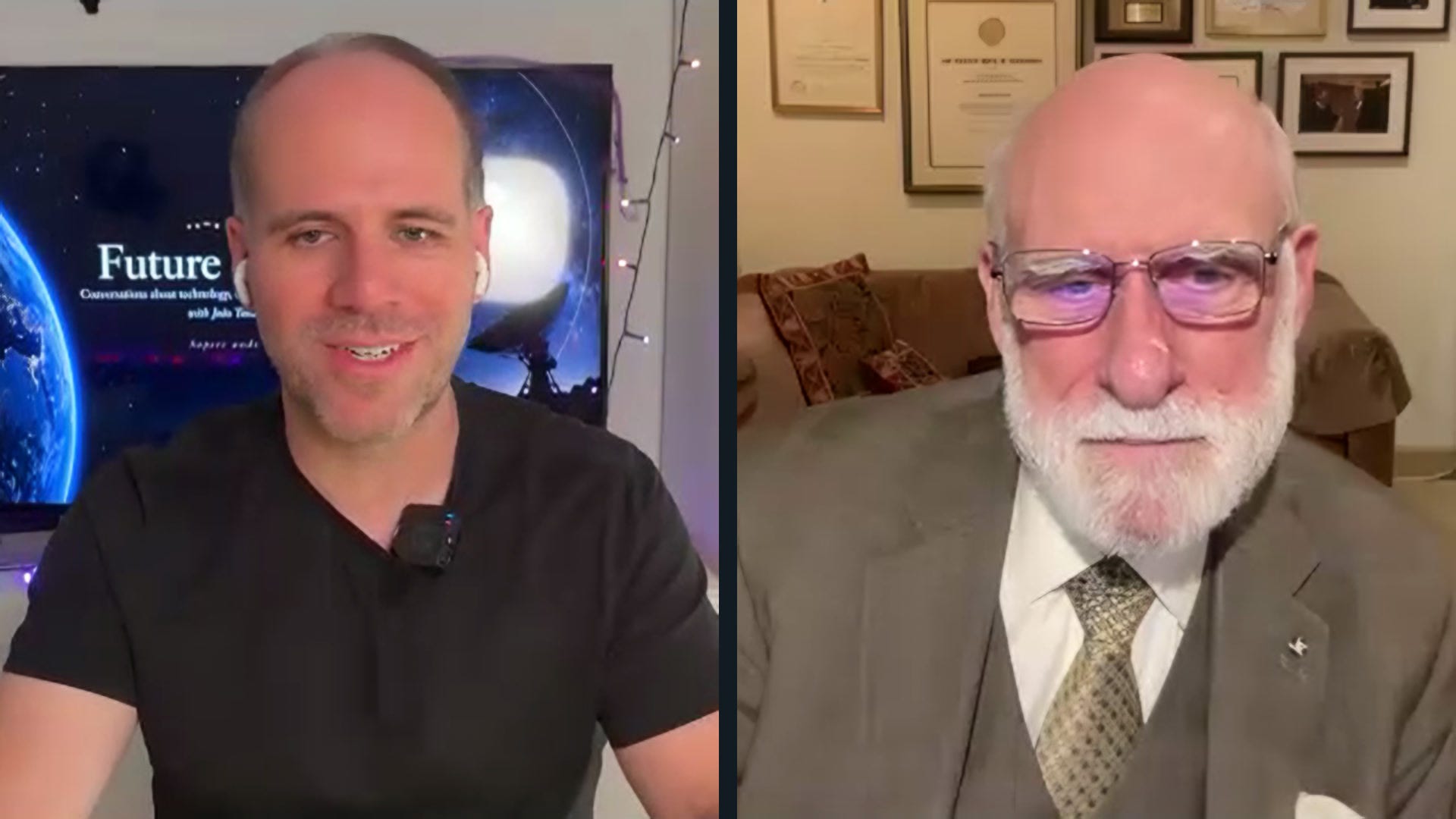
“Who will our allies be 25 years from now? And we didn’t know. So we thought the only way we can be assured that the allies will have access to this is to simply open it up.”
First, a bug related one (ring a bell? those never stopped over the years…). Vint once spent two weeks on a program that failed at random, so he couldn’t reproduce it. He finally asked his best friend, Steve Crocker, to step through it with him. At one point Crocker said “that’s the problem”, and he was right. Thirty seconds, after two weeks. Vint’s takeaway is that this is why collaboration matters.
Then a bottle of glitter. In late 1989 three commercial Internet services started in the United States, and one of them was called CERFnet, in San Diego. They first wanted to call it SURFnet, because surfing the Internet, but a network in the Netherlands had a name too close to it. So they asked Vint if they could use his.
He had a moment of “what if they screw it up?”, then decided that people name kids after other people and nobody blames the person they were named after. At the launch, he and the network’s director smashed a plastic bottle of glitter over a Cisco router.
He also tried to connect Minitel, the French online service, to MCI Mail, the email service he built in the 1980s. MCI Mail was designed to link to everything. It reached the telegraph system, which he calls 19th-century stuff, and fax. It even reached the post office: type a postal address into the email and they printed it, put it in an envelope and mailed it. Minitel refused to connect, and he says he still doesn’t understand why.
One more, from outside the interview: In 2020, someone on the Internet-history mailing list (I’m on it) asked if anyone had ever seen Vint without a three-piece suit. One reply: “I have seen Vint in a t-shirt!” Vint answered with just a photo, “IP on Everything”, from a 1992 engineers’ meeting where, in his words, he “felt compelled” to do an “IP on Everything” striptease. The thread is public.
We didn’t go very deep into AI. Time was short, and it’s not his main field these days. But even there, he has a clear way of thinking about it. And near the end he shows a piece of the original ARPANET on camera, and talks about his worry that the next century won’t be able to read what we leave behind.
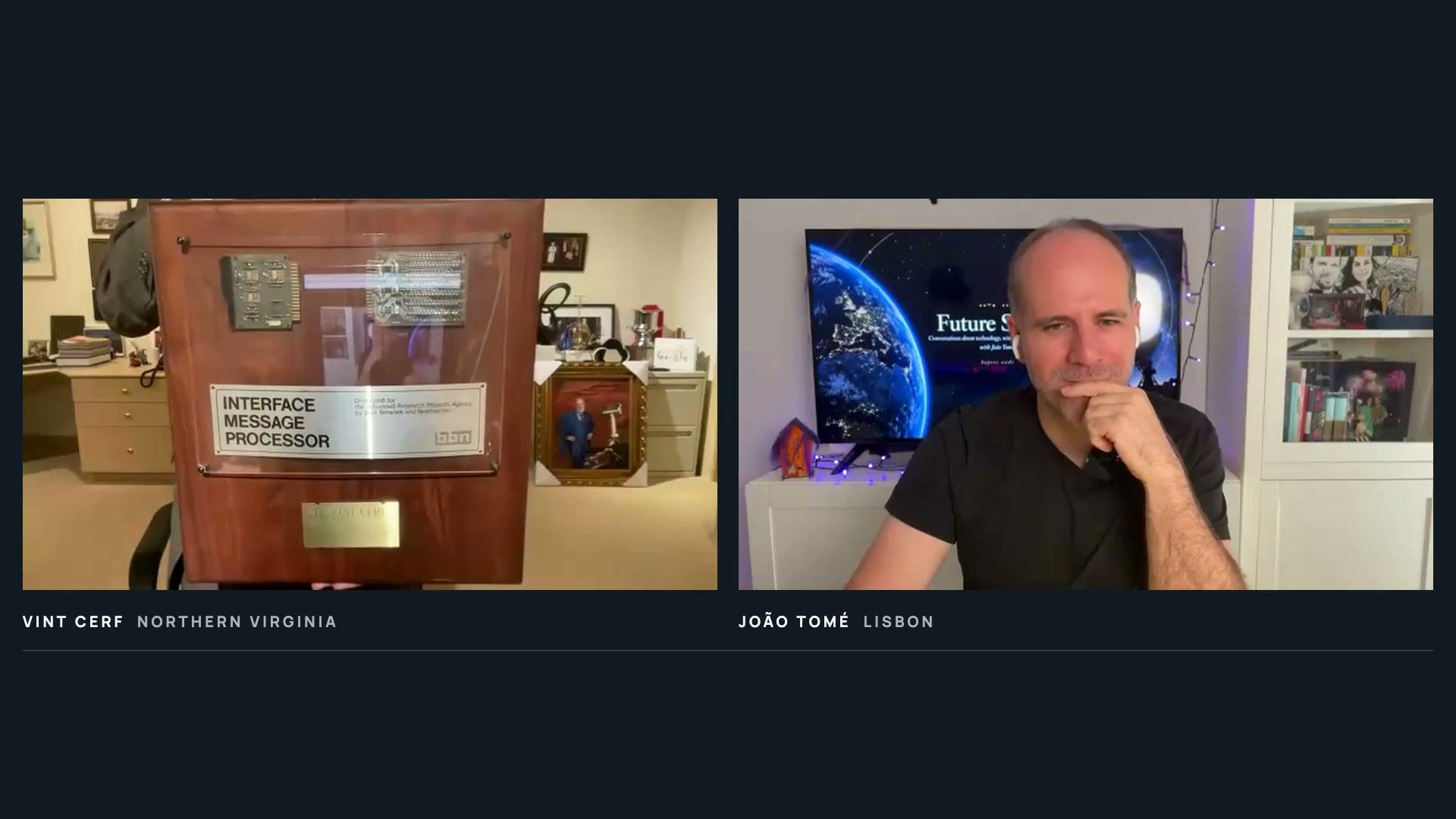
“I’m worried that the 22nd century won’t know what happened in the 21st because all of our records will have evaporated or will be uninterpretable.”
The full conversation is 56 minutes, with chapters:
You can also read the transcript at ourfuturestories.eu/vint-cerf, or listen in your favourite podcast app: ourfuturestories.eu/subscribe. A Portuguese article about it is on SAPO. Short clips are coming in the next days.
This is a passion project. The idea is to tell good stories, the kind that hold up over time. If you like it, subscribe, share it with a friend, and tell me who I should talk to next, you can do it here: ourfuturestories.eu/#contact.
Stay tuned, geek out!
———
Fun fact: in 2024 I did a segment on the 50 years of the TCP paper on my previous podcast, This Week in NET at Cloudflare. My guests were three then-colleagues: Mark Nottingham (standards), Marwan Fayed (research) and Lucas Pardue (web protocols, co-chair of the IETF’s QUIC working group). You can listen here (or below).
The paper is “A Protocol for Packet Network Intercommunication”, by Vint Cerf and Bob Kahn, published in May 1974 in IEEE Transactions on Communications. It described TCP, a way to join many packet networks into a network of networks. TCP was later split into TCP and IP, and in 1983 they became the core of the Internet that DARPA launched.