How Amazon Survived the Dotcom Bust - Commoncog Case Library
Amazon is known as one of the few dotcom darlings that survived the dotcom bust. This is how they did it.

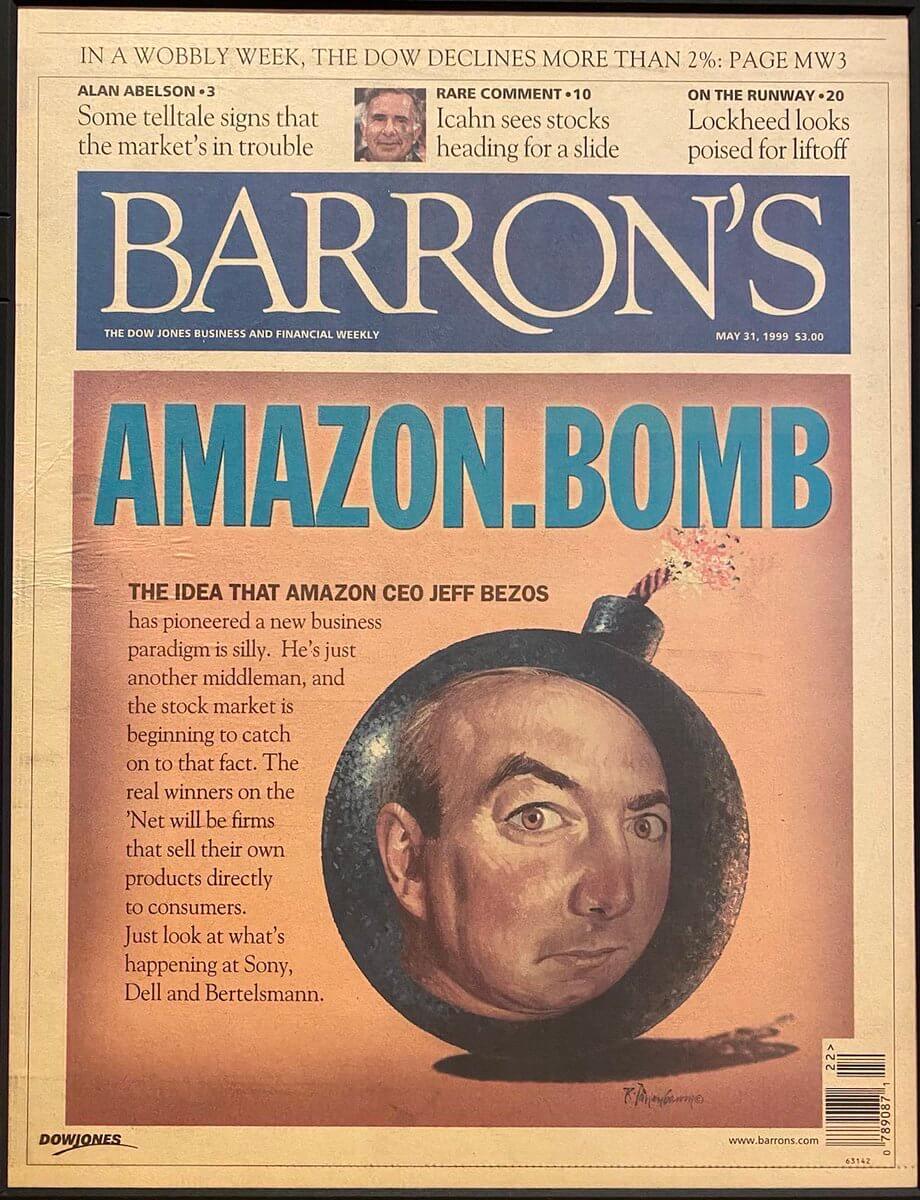

Sometime back I said that Commoncog will, as a service to members and readers, begin publishing cases of people and businesses who have had to go through disruption. We’ll look at cases where folks handled such disruption well, as well as cases where they failed and handled such disruption badly.
Hopefully it’s clear why we're doing this: given what’s going on with AI, it’s probably useful to fill one’s head with such cases of past disruption. That is, we want to calibrate ourselves for what may or may not come.
I’ve actually already started a concept sequence for this: Navigating Disruptive Shifts. The most recent addition was The Swatch Case, which I originally commissioned because I thought it was a clear case of technological disruption. (We now know, of course, that it wasn’t nearly that simple.) But no matter: there are other cases that I’ve queued up for this sequence, and we’re going to publish them over the next few months, starting today.
Later this year, Commoncog will publish increasingly complex cases about prior technological revolutions. We haven't started doing this because writing cases about entire technological revolutions are a lot more complicated than writing cases about specific companies or specific events. But we’re working on it.
But this series is here, and it’s about dealing with disruption.
Note that ‘dealing with disruption’ is not limited to technological disruption. Disruption, after all, can come from many places. As a trivial example, you could build a business selling fast food, and then suffer as a consumer fad for salads take over.
This week, we’re adding a new case to the sequence, that will serve as the official ‘kickoff’ for the entire series:
This case — on Amazon’s experience through the dotcom bust — might be relevant if you’re — I don't know — building with new technology in an equity market that’s excited about said technology. And then that market tanks.
As we’re kicking off the entire series, though, I want to address a question that some of you will have. Inevitably, someone will say something like the following: “Artificial Intelligence is new, we’ve never seen anything like this before, everyone will lose their jobs, this disruption will be unlike any other that has come before, therefore we know nothing, therefore history can teach us nothing.”
This is a fair objection.
My answer shouldn’t surprise longtime readers. It overlaps somewhat with my objection to reading history for lessons, or against skipping history because survivorship bias. (To be clear: a) we shouldn’t read history for lessons; b) survivorship bias is not a problem if you know how to read history in a particular way. You may click both links above if you're not familiar with either argument because they are both useful, but you don’t need to — those arguments are not critical to the one I’m about to make here)
The argument I’m going to make is this, and I should note that it’s not mine (it was originally from the researchers who published Cognitive Flexibility Theory). First, let’s assume that every revolutionary technology was revolutionary for its time. That is, when the technology was new, nobody could’ve predicted what those technologies would do to their companies, their markets, or their lives.
Let’s dump all such cases into a set of its own. Let’s call this the “100% unique set". Yes, this is a thing you can do. Notice that the meta-pattern uniting all of these cases is “how folks respond to this completely novel situation”. Everything else will differ — naturally, because everything else is ‘revolutionary’. But we may anchor ourselves on the reactions of the folks caught in the middle of the storm.
So what you may then do is to examine this set and ask: “When folks were facing something completely novel and did well, what did they do? What happened? When folks did badly and got disrupted, what did they do?” And then, on a case by case basis: what are the surprising similarities and dissimilarities with other cases?”
This is, of course, Commoncog’s Calibration Case Method in action. Note that we’re not building a causal model here. We’re not looking for universal patterns because reality is complex; things that work in one situation don’t necessarily work in another. But if you do this exercise — and you absolutely can do this already: we’ve got 12 case studies in the Navigating Disruptive Shifts concept sequence right now, so there’s more than enough to start — you’ll find that there are already interesting patterns to the cases. Not in all of them. But in enough that it’ll make you go hmm.
I’m not going to reveal what I think they are. I want you to read the cases in the concept sequence and then record a voice note: what did you notice? What leaps out at you? Dwell on it a little.
We’ve got a few more cases to publish. and then I’ll give you my reaction. In a few weeks.