Some observations from my War of the Lance (1989) Code Harness assisted modernisation (WIP)
I gave Qwen-3.8-Flash-Next a job: Reverse engineer and port War of the Lance (1989) to modern browsers. It took about a week, primarily because I can only run a single lane on my workstation due to VRAM constraints, but it got the job done: Faithful reproduction of rendering and game rules in a new Three.js rendering engine.
A few days ago I started modernising it into a Total War meets Heroes of Might and Magic like experience that you could actually play without getting a UX aneurysm. But doing so while keeping the original “underneath”.
After a few hours, it looked like this (see also the video in the attached LinkedIn post).
In the past, one would have chosen another AAA game for a “total conversion”, but in this new transformer world, synthesising the exact features and renderer is easier and faster.
It's not just code
With the Fable 5.1 just released, there was an opportunity to see how the frontier improved on modelling with Blender and it's pretty good and definitely a significant step up from Opus 5, quite usable in fact for this type of game.
The workflow here is to have the model write python code that leverages Blender's headless mode APIs to create web-usable GLBs. It's fast and token efficient, you can model about 80-100 models on a week's worth of Fable subscription.
That's not good enough for most use cases, but let's not kid ourselves, the specialized models will get there.
Edit, just one day later: I got access to GPT6 Astra and it clearly was trained on 3D modelling and it significantly moved the bar. Where Fable was a junior modeller, we're now into mid-career professional land.
OpenAI was smart here, they saw everyone benchmarking on one-shot Three.js scenes and benchmaxxed all the way into that direction, knowing the internet will use it as the sign of impending AGI. Coding performance seems ... significantly less improved.
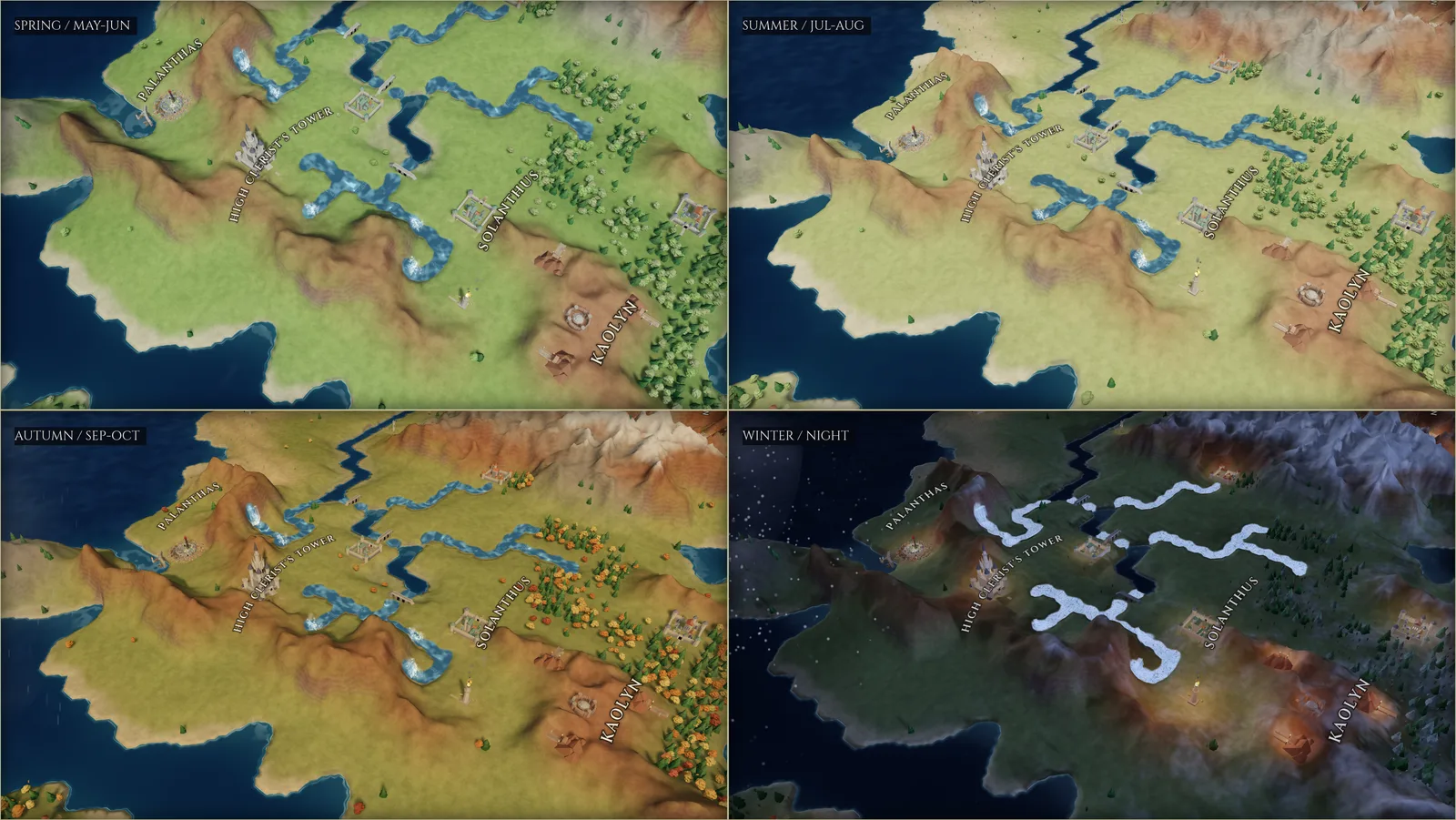 Want to add seasons, day/night and three moon phases? Well, that'd be 15 minutes and $2.28
Instant, usable 3D assets, placeholder or not, “unbounds” design - you can now order custom assets for anything you want as a token micro-transaction, only limited by renderer considerations.
For War of the Lance, all of this - the complex task of reverse engineering, renderer optimisation and then building something new on top of one of the most fickle platforms of all, browser based web - involved a single person with a full time job and less than 4 hours of dedicated attention to the harness over a week.
It'll be interesting to see how AI really changes modding now that every game is becoming moddable given the powerful reverse engineering capabilities available.
The trend line is brutal
What matters in the end here is the trajectory:
- A local model equivalent to a frontier model from April or May can reverse engineer and port a game like this in a week on a business workstation.
- If given access to cloud APIs to dispatch worker lanes, that drops to 2 days.
- A September 2026 frontier model can do it in a few hours with ever shrinking human intervention and that time will shrink to minutes in the coming 18-36 months.
Try a speed optimised model like gpt-5.3-codex-spark or a Cerebras-accelerated model and you get the idea.
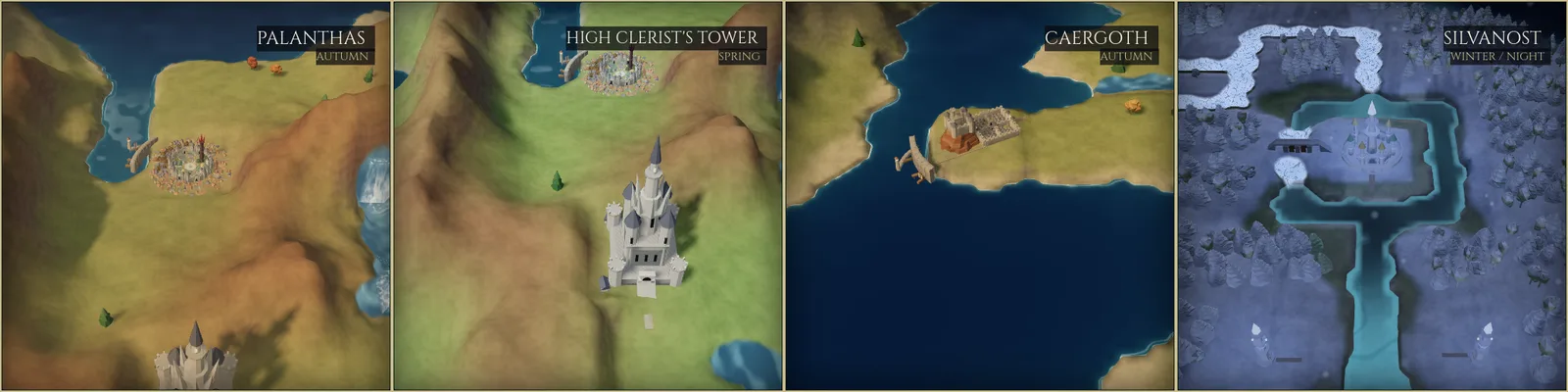 Custom models for every city? We're not competing with GTA, so we're no longer asset-budget bound, just renderer bound and /auto research <make fps go up> does the job...
I have a good sense of how things are moving, because, since the start of the year, I've been porting retro games to web, and often upgrading them in the process.
A selection, some finished, others work in progress:
- Kaiser 2 (C64)
- The Adventures of Robin Hood (PC)
- Ultima 6 (PC) 3D Port (WIP) Demo
- Populous (PC)
- Populous 2 (PC) ++
- Syndicate Plus (PC, 1995)
- Dungeon Keeper (PC)
- Darklands (PC) ++
- Red Baron (PC) ++
- Ultima Underworld (PC) ++
- Strike Commander (PC) ++
- Eye of the Beholder 1, 2 (PC)
- DragonStrike (PC) ++
- Test Drive III (PC) ++
- Pirates Gold (Windows) ++
- War of the Lance (PC) ++
- Conquests of Camelot, Police Quest I, King's Quest I
- A web Dark Age of Camelot Client (Wikipedia) ++ (Currently stuck in Opus 5 hell)
- A web Ultima Online Client.
Some of those projects were easy - simple C++/SDL to TypeScript/Three.js transpositions as prior reverse engineering existed in various open source projects, but others required full reverse engineering (++)
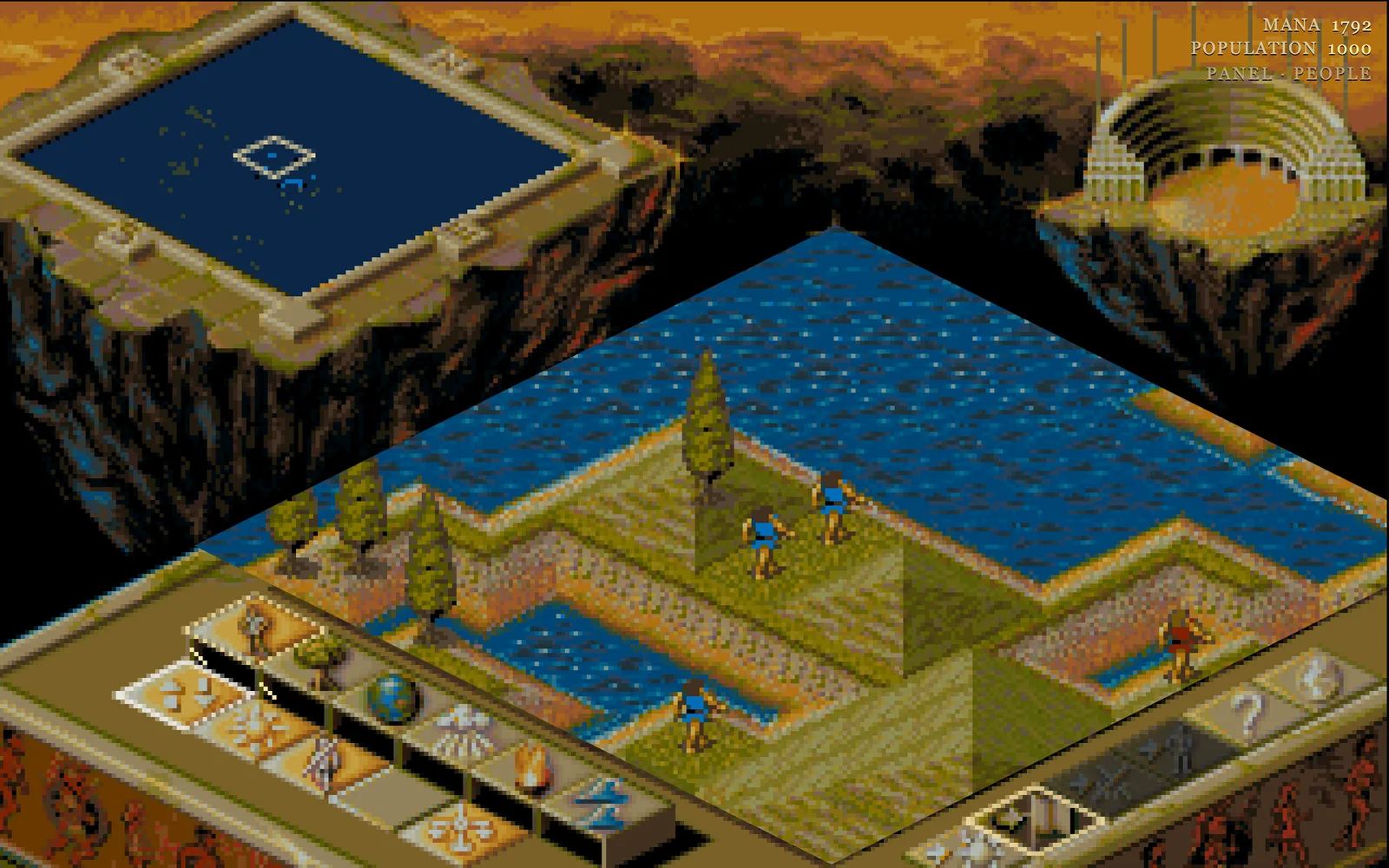 Populous 2 was a hard RE job... until I realised Opus 5 is just bad.
It seems obvious to me that the leverage of an experienced software engineer here has changed completely and it is obvious to me that minor-version bumps and single-digit benchmark-score gains posted with new models are misleading to the maximum:
Since the start of the year, the ability to execute long range, complex tasks over hours, even days and eventually converging on the goal has skyrocketed (except in Opus 5, which is a clusterfuck that doesn't converge).
 Yo, that's Zuck with Pervert Glasses watching your agents in my Syndicate (1996) port, which replaces the nameless dystopian corporations with their real world counterparts 30 years later.
🤖 It's no longer the job it used to be
The human is a “bot herder” now whose role is to provide intent, taste and occasional critical validation.
Knowing what you want or, in the absence of that, knowing what to choose from infinite options generate for you.
I never touched an IDE, Blender, RE tool, commandline, source control in this project. I don't know what the code looks like but I know it meets the linting and code quality requirements enforced by the harness on every run, frozen in stone by the tests created on the way.
Not even QA is untouched:
The harness can play, in a matrix kind of way, the old game in DOSBox-X, staring at memory dumps and disassembly like Neo to divine what is, and play its own creation via Playwright, inspecting DOM and memory as well as using multimodal vision to perform visual analysis ... all while writing tests that prevent backsliding or regression.
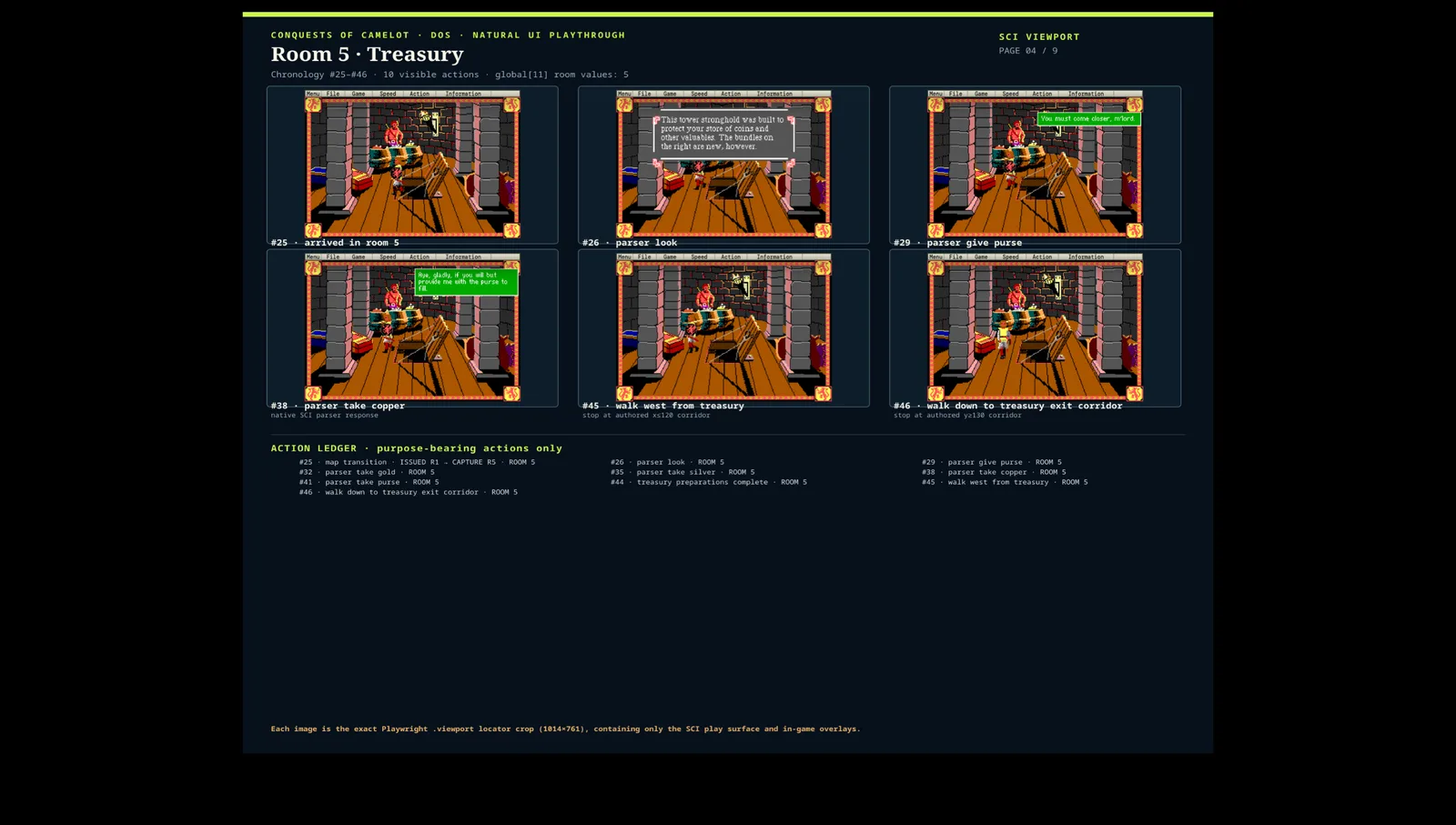 Page from an autonomous playtest report by GLM5.3-Flash playing my port of Conquests of Camelot, carefully accounting for every action, one page per room, uploaded to me upon completion.
Reverse engineering is a great example because it essentially is deep copying from artefacts that were considered safe to distribute.
With Copyright and IP roadkill to AI models in most economies, that's a problem.
But does it generalise?
One may be tempted to say "reverse engineering and porting is not the same as creating", and that'd be true, but it misses the point:
The act of reverse engineering and porting decades old games to modern environments requires a complex, deeply involved set of tasks from multiple disciplines. In the past, the required combination of skills was exceedingly rare to find, maybe a few thousand in the 320,000 people strong professional industry workforce and it used to take months, if not years to do a single game.
It's the quintessential deep, skilled knowledge labor profile out there that people understood as a career protected by depth of skill and knowledge acquisition.
No More. The transformer and the associated destruction of intellectual property protections end this, commoditising knowledge that took decades to learn in seconds, turning the previous knowledge sharing economy on the internet against its contributors and creators.
 This prompt made a somewhat working port of DragonStrike (1990, DOS) in 8 hours with Fable 5.1. It was unfinished and had blind spots, but about 85% without any human interaction.
Another point here, speaking as an industry veteran, is that the boundaries are fluid. Creative work like games always transformed work from different domains, and only a small share of it is truly new in most games.
Transformation, the transformer's special trick, cuts like a knife into the idea that creativity is special once you understand that people perceive ideas novel to them as creative and the transformer holds every published idea ever in its bowels. Enough to saturate every human with endless "new ideas" forever.
Here we have an old retro game that transformed the books and stories by Margaret Weis and Tracy Hickman and the intellectual property of Gary Gygax and TSR, Advanced Dungeons & Dragons, fusing it with the war gaming ideas and concepts developed by SSI into a unique experience.
The transformer takes it, on human command, and fuses it with the concepts and ideas of Creative Assembly (Total War), the work of people on the WebGL and WebGPU SIG at W3C and the "taste and decisions" of the human behind the LLM and produces the infinite results a creative can hone and iterate on.
The Transformer solves the knowledge economy
Contrary to the noise and smokescreen about AGI the techbros are deploying to collect more and more rounds of investments, the transformer does not solve human intelligence. Not even close. But it does "solve" a fundamental aspect of our economic system, with absolutely devastating long-term effect.
The knowledge economy is structured around the problem of diffusing and applying knowledge into the economy. We do this through education (bootstrap) and continuous learning.
Human brains are the storage medium and application device for the knowledge in this economy and the difficulty of acquiring knowledge and its reliable application are the price-making mechanism.
A medical doctor having to spend 15 years to acquire the knowledge is price and paid better than the grocery store manager primarily due to the difference in knowledge acquisition.
The transformer competes here as a medium and partial applicator, with economies of scale and centralisation creating economics neither human nor smaller players can compete with in our current economic system.
As human and horse found out during industrialisation, you can't outrun an internal combustion engine; it's likely humans won't be able to out-memorise and out-apply a transformer for the Pareto 80% of cases in the long run, especially if quality enforcing regulation is gutted.
Reliability concerns (but it hallucinates!), copyright and legal responsibility would offer friction against a quick victory march here, but as we all can see every day, the battle over regulation, the ultimate arbiter of what reliability is required in society and copyright is being fought with more money than ever assembled in the history of mankind.
 That screenshot of the four seasons up there? It was a prompt
Scarce indication exists that copyright or stringent regulation on quality would succeed in stopping it in the current political environment in the US. Meta walking away with a slap on the wrist while managing to entrench their age-verification regulatory capture at the same time should disabuse anyone of the idea this has a happy ending where old rules prevail.
But there will be new jobs...
Probably, but we have a problem here: We have a technology that given enough data about a job can abstract the rules and replace the creator in the process. And we have economic incentives that guarantee that if the job is valuable, someone will fund the model to attack it.
It's important here to not fall for the techbro hype: This process will take time, a decade, maybe more, because most jobs are vastly more complex than advertised and the economics of optimising highly optimised systems are not in favour of new, unreliable frontier technology.
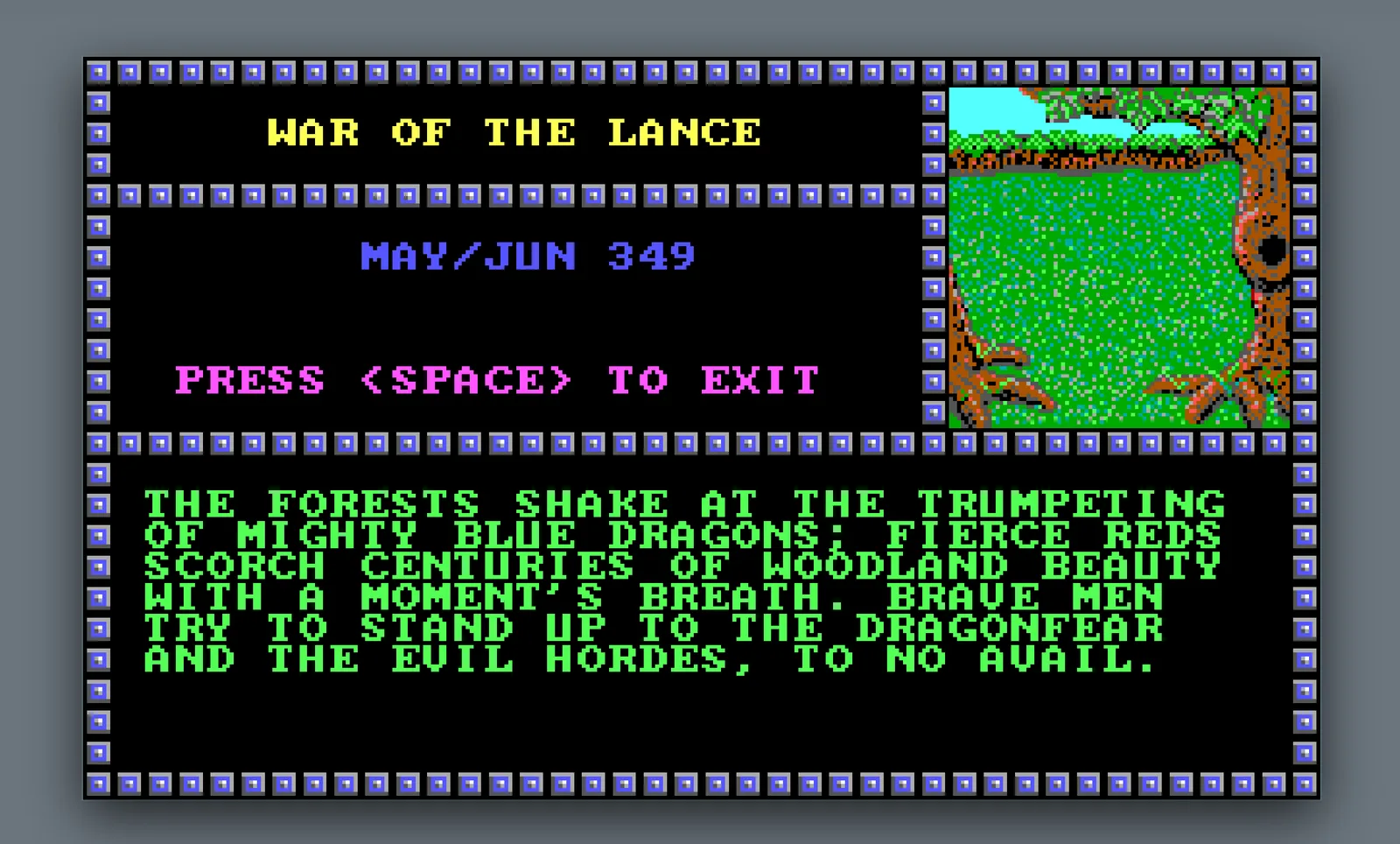 Old UIs are perfectly serviceable, why change?
But systems thinking helps us to understand where the incentives are pointing and, fused with the fact that software acts as "machines for the knowledge economy" (in the industrialisation sense of the word) and that making software is getting extremely commoditised as we speak, we can absolutely predict that the impact here is going to be biblical:
It's digital transformation on steroids while the underlying system of rules and IP laws, trade and treaties crumbles.
IP or Transformer, choose one!
You can't have an IP-based economy and pervasive AI use everyone defines as the future with current laws, because the transformer launders and strips copyright and copying beats creating every time.
The advantage new creators had in the past was that their work could go "viral" and find a market before the competition could react. That time is over, the transformer guarantees it with brutal economics:
Whatever you spend designing, researching and testing to make a great product, your competition will spend on marketing instead, having reverse engineered your product for pennies.
🌊 The Coming Storm for the Game Industry
The game industry (and other knowledge sectors shortly thereafter) are staring at a commoditisation tsunami of change unlike anything that ever happened.
The water has already receded but people are fighting on the beaches about whether it's really gone, whether it is just cyclical and will just peacefully come back or that the pristine cities built by professional developers will weather the storm because “quality”.
It is clear to me that every single job profile in the industry will change, with many not surviving the transition.
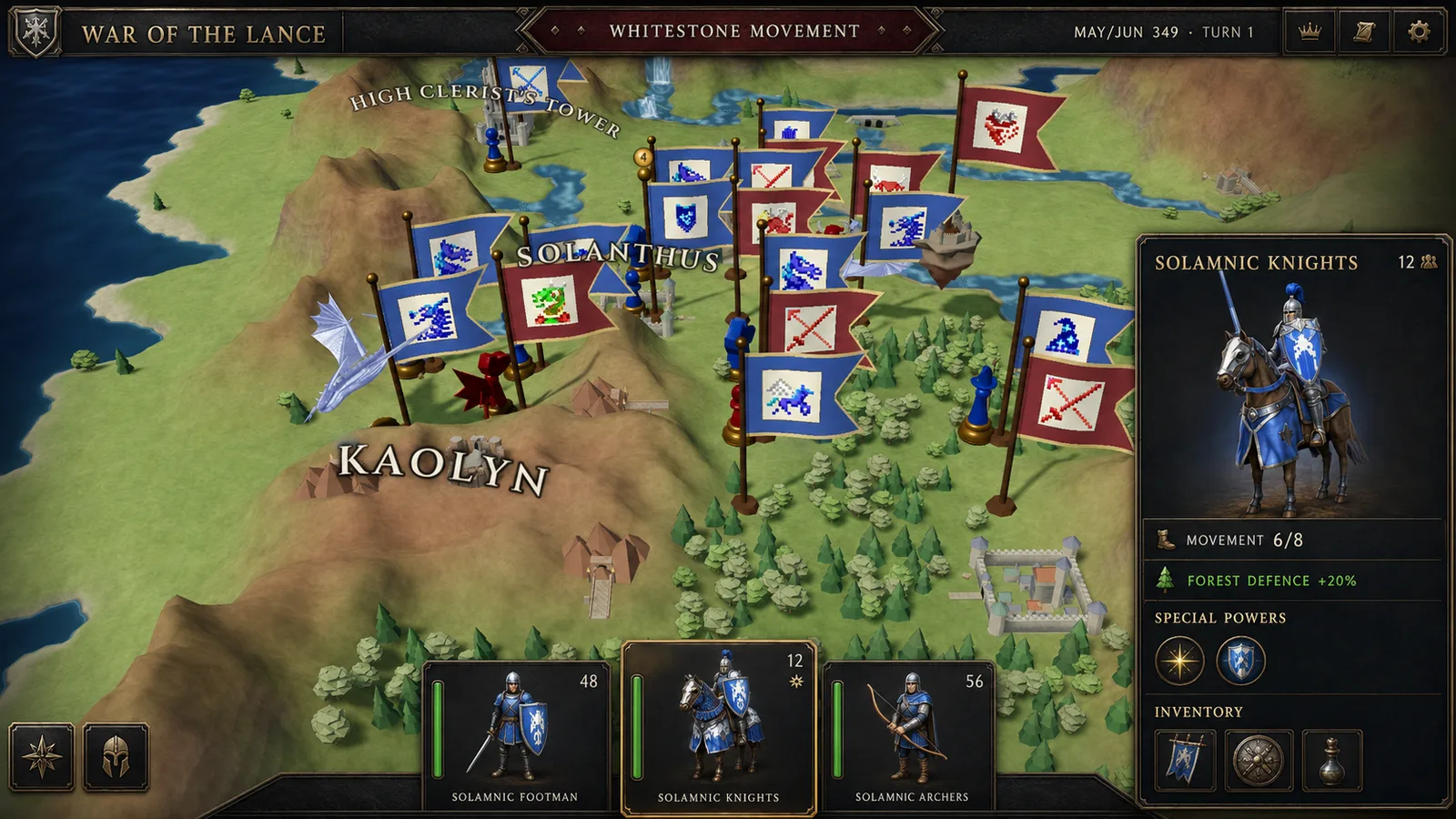 "Let's prototype a Total War Style UI Chrome, but with X, Y, Z", we're just splicing genes, or tokens and it takes minutes to see the result.
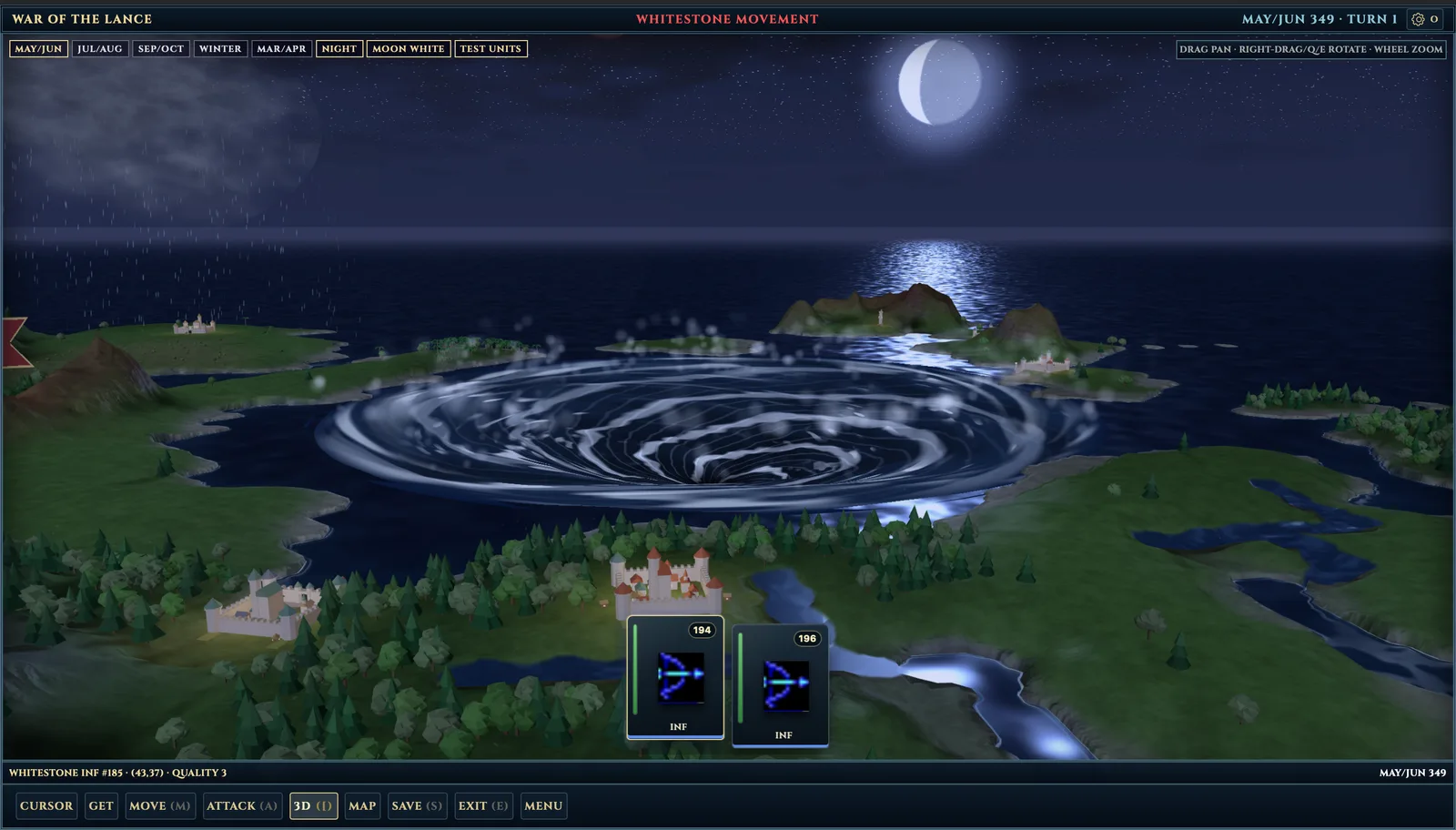 Or less polished, the Maelstrom in the Blood Sea of Ishtar after the Cataclysm feels like an oddly fitting image here...
Everyone with a career stake in this industry (and others) needs to very quickly start thinking about what “higher ground” means, but as far as I can tell, there may not be any truly safe ground.
Societal and corporate inertia may protect other industries a while longer, but gaming has always been a frontier business.
Is it Rockstar's continent sized shiny brand fortress, defended by a giant moat of money and sheer scope?
Is it building an ark for your community?
There's always exceptions, we all know this, but realistically, what are the prospects for the Pareto 80% of the industry? Not good during the flood, but who knows what comes behind it.
Where are the winners?
While it may be tempting to get hyped up about being able to build so much more so much faster, we cannot ignore that these capabilities are available to everyone, that there's precious little moat, especially if IP doesn't survive the slaughter.
 How will this end?
Ask journalists. Their moat was publishing and access to information and Big Tech gleefully handed that to everyone, showing us in the process that professional, expensive quality is not nearly the moat people think it is. As if Roblox and Minecraft didn't teach us that already.
"Commoditize your complements", this strategy is called, and it ensures the real winners will be the attention platforms run by large technology companies.
The easier it is to create content the more content is created. The more content is created, the more competition for attention. The more competition for attention, the higher the ad auction prices to reach eyeballs - leaving everyone but the platform to fight to the margins.
How commoditised?

I'm not sure anyone would play it if they knew there's only tokens, no soul, but the ad pushing it to them and drowning out your handcrafted game won't mention any of that and the time where AI slop is easily recognisable is very quickly going to come to an end.
And having spent less than a McDonald's Happy Meal on "making" the game, I have plenty of cash on hand to pay for featuring. Cash you spent on designing, testing, producing assets and more.
And if you actually stumble onto something interesting and fun...
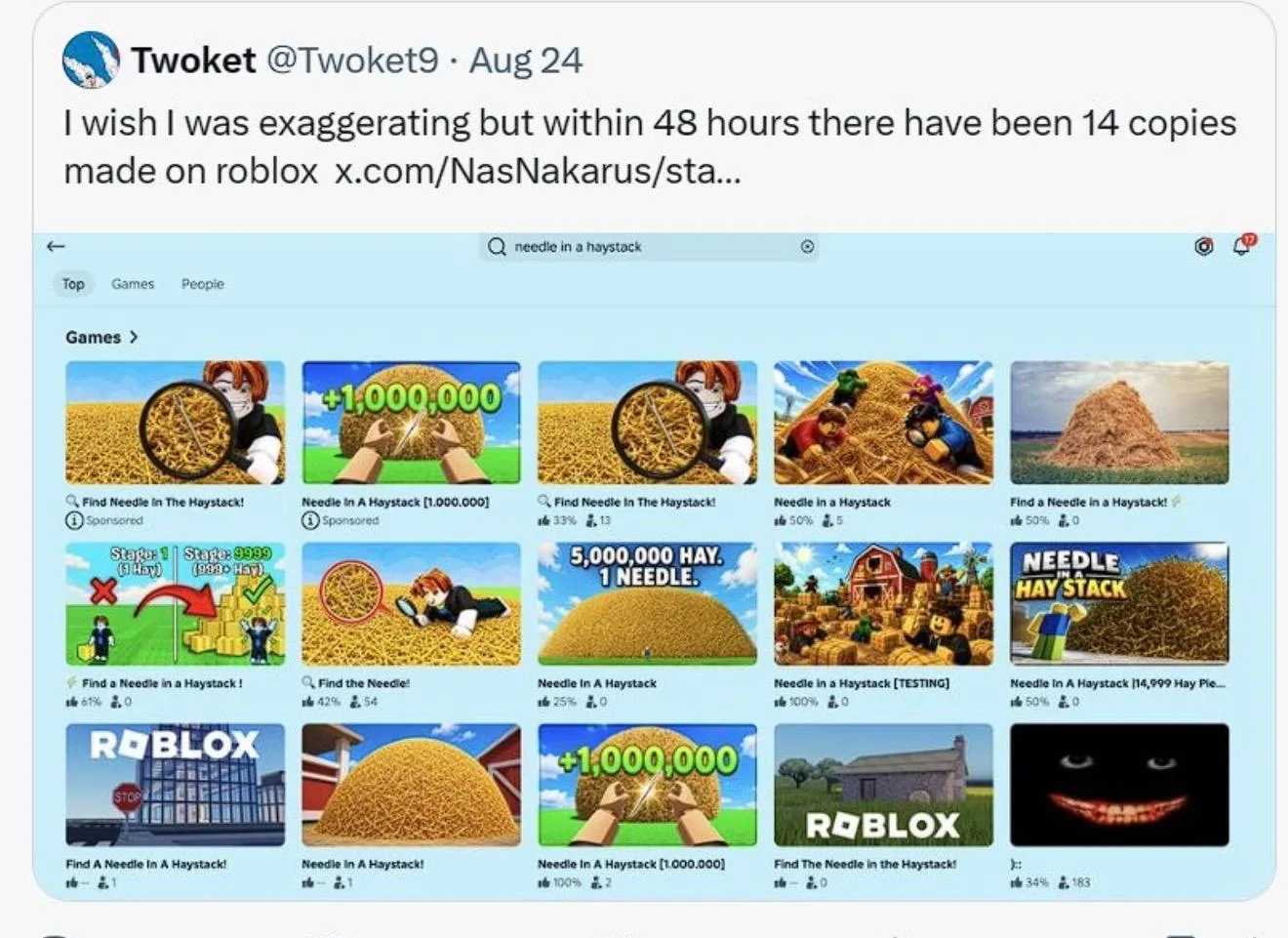
That's really bleak
Yes, but it's just mapping incentives and a bit of system thinking. The transformer will smash our economic system and cause massive redistribution, by default to the techbros, because they got all our knowledge and economies of scale.
There's, even in the bleakest times, opportunity for smart people. But it's not useful to pretend that's a plan for the majority of people working in the industry right now. Or any affected industry.
On the positive side, we can now make games as political commentary over a weekend targeting that one viral trend that's happening right now. I don't know how to feel about that though...
Technology stack
- omp harness
- Qwen-3.8-Flash-Next (256k, Multi Modal, on an RTX 6000 Blackwell MQ workstation): Reverse Engineering and coding
- Claude Fable 5.1: 3D Models, Reviews
- GPT-Codex-Spark: Mass high speed code transformations (AI slop gate)
- DOSBox-X, Radare2, open box as reverse engineering framework
- Blender headless: Deterministic modelling.
- All Skill synthesised out of the model weights themselves.
Some learnings, in lieu of hope, may you find them helpful
Game specific observations
- The source code for many retro games has been lost, preventing them from getting remakes or remasters. In 2026, that's not a problem anymore.
- Start by asking a frontier model to collect and organise research about everything that's known. Add your own available information, manual, assets, etc. to it. Having a starting point makes reverse engineering evidence gathering much easier.
- Ask your model to build DOSBox-X from source and patch it to enable direct control, it helps a lot. Squelching noisy debug messages also helps.
- For web ports, all you need is bun, vite 8, Three.js and SolidJS. Everything else is fluff.
- Games with bytecode VMs, like The Adventures of Robin Hood, are easier to port, because once you port the VM, all the content falls in place and testing the VM is easy.
- The only cost of supporting mobile is asking for PWA support and coming up with an intuitive mobile interface. Unless mobile is the primary target, do it once the game is finished.
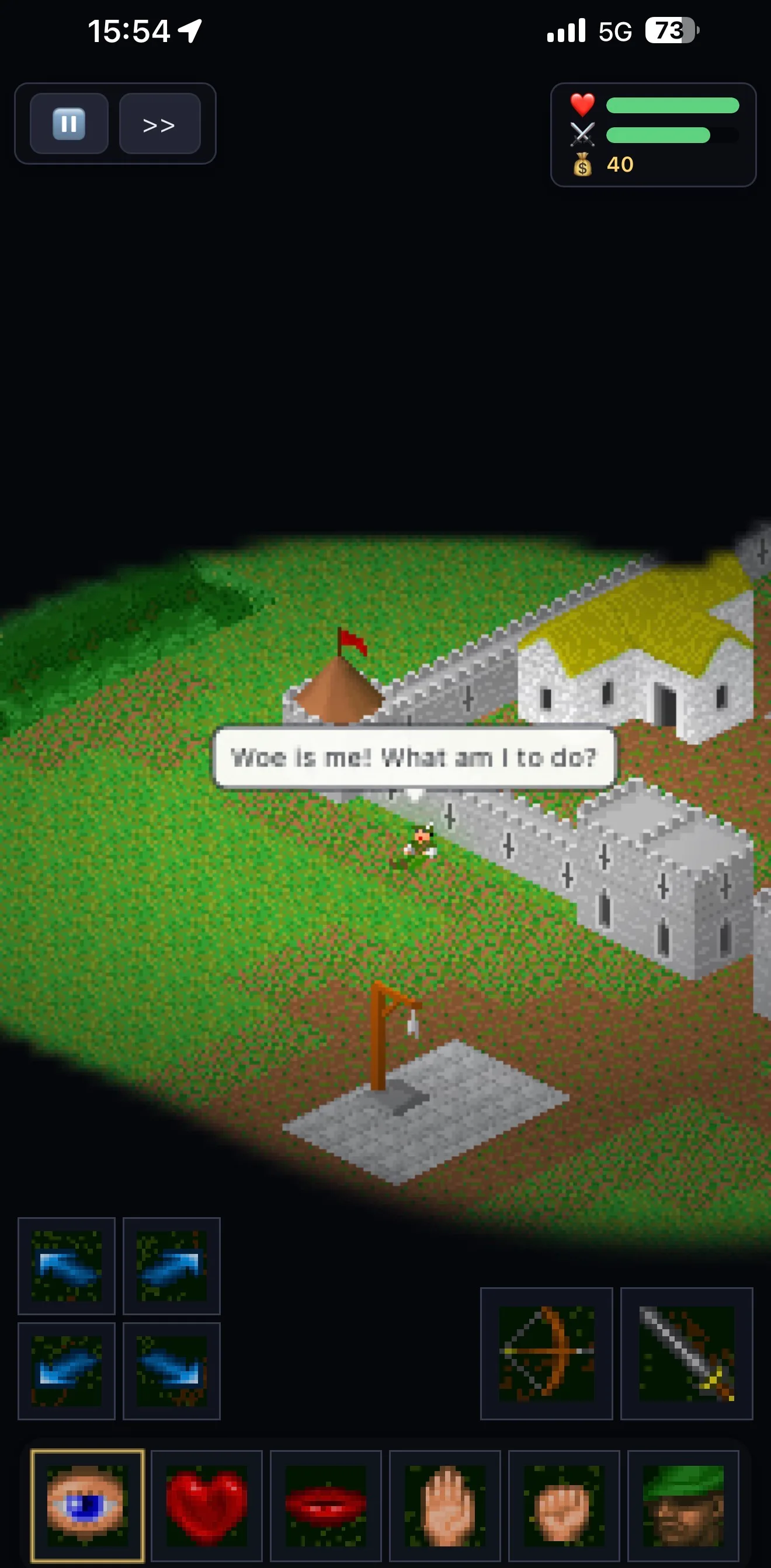 The Adventures of Robin Hood (1991) running with a new mobile interface and digital joystick as a PWA on an iPhone.
- Be very careful with your project charter. Lay out what you want to achieve and where you want to go. Avoid "byte accurate port" at all cost unless that's truly your goal, because that's a hard gate that you'll burn a lot of tokens for little progress.
- There's no reason why any of this can't work on modern games or with a modern game engine like Unreal.
- It's likely 3D modelling will be "solved" like image generation before the end of the year. Once things reach "crappy outsourcer asset" level, the industry's existing tools, used by the LLM, will finish the job.
- Strangely I haven't seen much harness commandeering Houdini yet. It's bound to happen...
Harness Engineering
- Ignore free models. They are quantised to hell and not comparable to the frontier models. Plus they all train on your data. Some paid models, like Deep Seek, do so in any case, keep that in mind.
- The code harness is the tool to end all tools. There's very little reason to buy any fancy AI solutions, frameworks or specialized products. All you need is omp, codex or claude code.
- But you're not stuck glued to the terminal. Just ask it to create a mobile PWA page with whatever you need to supervise the project progress, like progress reports, checklists or even screenshots or videos.
- Code Models are improving much more rapidly on code tasks than their benchmark scores show. Expect that to continue for a while, we're still in the early days and significant leaps (like Qwen-3.8-Flash-Next) happen every week.
- Use an orchestrator model and specifically instruct it to launch sub-agents for specific tasks, including planning.
- Local models can work, but don't make economic sense at current hardware cost. Use them for the right reasons - business continuity, privacy and IP protection. You have to assume everything you feed into a proprietary model will be used for training.
- If you're cost-strapped, consider a subsidised codex subscription, use omp harness with it and ask gpt-5.6-sol to launch GLM, Kimi or Deepseek lanes, they are dirt cheap on the API and you don't need a coding plan and can do the job just as well.
- Avoid frameworks, skill repositories and MCP servers. Not only are they security risks of epic proportions, they just can't keep up with the rapidly changing models, which means the practices they encode become an accuracy drag over time.
All the knowledge for most tasks is in the weights and a simple "what are the best practices for reverse engineering DOS games on this machine" followed by "synthesise a skill to do reverse engineering of dos games based on these learnings" is enough to retrieve them.
When you understand this last point, you understand the power of the transformer: It contains all knowledge ever published, in lossily compressed form, but also the steps to acquire it.
- GPT-5.6-sol was able to make Qwen-3.8-Flash-Next work on my Blackwell card with excellent performance within 24h of the open model release, performing some impressive optimisations like patching SGLang in the process. It convinced me that what's in the weights no longer is limiting to frontier models - they can extrapolate between weights and search results effectively enough to perform extremely technical tasks.
- omp harness's /prewalk is a beast, better than /plan mode even in Claude.
- Auto Research is an exceptionally powerful pattern for game development tasks like renderer optimisation, or setting up AI models and trying to squeeze out maximum tp/s or context. It's a poor man's generalised RL lab at your fingertips. Learn it.
- The real trick is to have the model write the right tests. It's quite tricky and some models (Opus 5) can lose themselves in running tests all day without making progress.
- At this moment in time, a codex max subscription is the best value for money, beating claude because a) it allows third party harness use (omp), b) their limits are very generous, c) the model, while in some areas like 3D models weaker, is extremely capable, less likely to refuse and, most importantly, faster. Bonus: gpt-5.3-codex-spark is an absolute beast for massive code base transformation in lightning time.
- One exception on tools and frameworks: If you're doing web development, I found bunx aislop scan to be an impeccable quality gate. Something like "After every major feature, run bunx aislop scan and correct any flagged issues. Learn the pattern of these issues and make notes to preemptively avoid them".
One of the things this does is to limit LOC, which is extremely important for token efficiency.
Update: Three Weeks Later
In the three weeks following this post, the state of the art on 3d asset generation already changed dramatically. GPT-6 Astra, GPT-6 Sol and finally Claude Opus 5.5 all moved closer into "Senior 3d artist territory" and show dramatically increased ability to optimise both assets and rendering engine code for performance tuning.
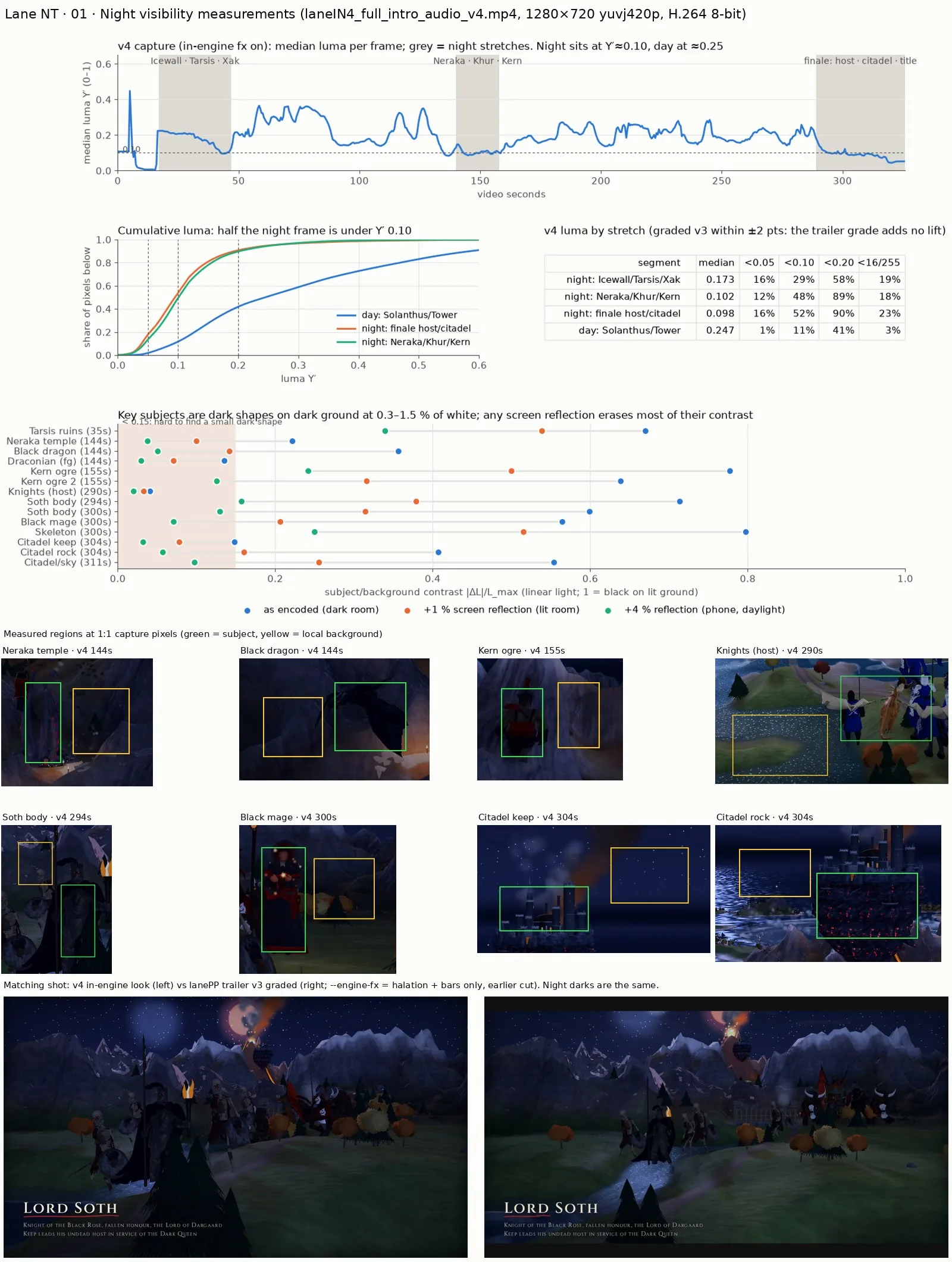 Having experienced the gruelling end of project performance optimisation crunch on several beloved BioWare games, the analysis and remediation a frontier model like GPT-6-Sol or Claude Opus 5.5 is able to produce is mind-blowing to me ... and scary
And here is the completely in engine, 60fps intro sequence video for "Total War of the Lance", created in approximately 4 hours. All assets are created by foundation models directly creating 3d assets, narration audio via Xiaomi's Mimo TTS.
About the Author
Georg Zoeller is an industry veteran and troublemaker with more than 25 years of experience across games and frontier technology, including AI.
He contributed to many beloved PC and console games at companies like BioWare, Electronic Arts and Ubisoft and led game industry aligned teams at Facebook/Meta working on products such as Game Streaming, Canvas, GameRoom, Instant Games, Gaming Video and Games Platforms solutions for many years.
He's provided AI strategy and technology disruption consulting to AAA studios, publishers and some indie companies over the last few years, but stopped because it's getting too depressing seeing everyone lose funding.
He writes without AI and has nothing to sell.