The mild pejorative yankee first appears in a 1765 American poem, in which it means “person from New England”. During the American Revolution, yankee typically referred to Americans in general. The term’s New England origin influenced its meaning of “northerner” during the American Civil War. Later that century, yankee meant specifically Protestants, as opposed to immigrant Catholics.
The clipped form yank, in evidence since 1778, still means “person from the US” in global English today. The Bronx baseball team New York Highlanders was renamed the New York Yankees in 1913. Their iconic Yankee Stadium was built in 1923. In 1956, Yankee was selected to represent the letter Y in the NATO phonetic alphabet on its creation. Yankee standing for Y was common usage in telephone spelling since 1945. Before that, the word representing Y was typically Yokohama.
The origin of the word yankee is disputed. Historically, it was attributed to a Native American language. A British officer writing in 1789 traces it to Cherokee “eankke”, meaning “slave” or “coward”. An 1822 overview of Native American history and cultures claims the original term was “Yengees”. Today, it is generally agreed that those explanations were false. The likely origin of yankee is the Dutch name Janke, a diminutive of the popular name Jan. The usage of “Yankey” to refer to a nonspecific Dutchman is found as early as the 1680s.
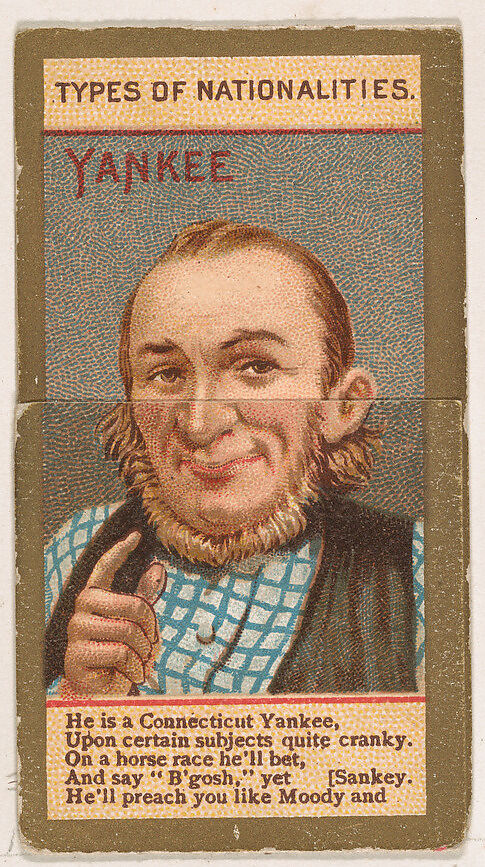 1890 trading card distributed as an advertisement for Kinney Tobacco Company. Illustration of a stereotypical Yankee, a portly fair-skinned man with slicked-back straw-colored thinning hair and mutton chops. He wears a vest over a plaid buttoned shirt.
The Dutch given name Jan owes its popularity to its prominence in the Bible. In Dutch translations, John the Baptist, John the Apostle, and his Gospels of John all bear the name Jan. In the original Greek, his name is rendered Ἰωάννης (Iōánnēs). Iōánnēs was a popular Jewish given name 2100-2400 years ago. It appears in the Old Testament as יוֹחָנָן (Yôḥānān), meaning “God has been gracious”.
Unsurprisingly, John and its local equivalents has been a popular name across Christendom and Islam for thousands of years. Some names that are also John are Ian (Scottish), Ivan (Russian), Jovan (Croatian), Yahya (Arabic), Giannis (Greek), Giovanni (Italian), Jean (French), Johan (Dutch), Hans (German), Sean or Shane (Irish), João (Portugese), Juan (Spanish), and Evan (Welsh). Some common women’s names that originated from John and friends are Joan, Joanna, Jane, Janet, Janice, Jean, and Jeanne. Jack used to be an English nickname for John, but has since split off into its own separate name.
Surprisingly, the given name Jon is unrelated to John. It is short for Jonathan, which is admittedly also a Biblical name of Hebrew origin that begins with יהוה (YHWH).